
For decades, hundreds of mine tubs travelled through the heart of the Panasqueira mountains. At first they were pushed by the miners themselves, while mule-hauled trains were formed in the main adits. Electric and diesel locomotives came later. All were essential to an undertaking in which breaking the ore was only half the problem. The other half was moving it.
As the mine expanded, so did its railway. Alongside the small tubs used in the stopes came increasingly heavy trains, locomotives, workshops, battery-charging facilities and even coaches for carrying the workforce.
Other lines operated on the surface for very specific purposes. One served Cabeço do Pião beside the Rio dressing plant. In a photograph published in 1945, a small steam locomotive stands at the head of several wagons loaded with sand. For many years, that image was virtually all that was known of this railway.
The story was, in fact, considerably more complex.
From the 450 mm-gauge mine system, later converted to 750 mm gauge, to the independent line at Cabeço do Pião, Panasqueira developed a genuine rail transport system over the course of the twentieth century. Mules, electric and diesel locomotives, and two steam locomotives performed distinct duties as both the underground workings and the surface plant were transformed.
1. A mine where transport mattered as much as extraction
From the outset, Panasqueira’s geography shaped the way in which the mine had to operate.
The mining field developed in the mountains of central Portugal, between the Gardunha and Açor ranges and the deeply incised Zêzere valley. At different times, Panasqueira, Barroca Grande, Vale das Freiras, Alvoroso, Rebordões and Cabeço do Pião—also known as Rio—were among the principal centres of an undertaking that was never concentrated in one place.
Geology contributed to that dispersal.
Mineralisation occurs in an extensive network of quartz veins, chiefly sub-horizontal or gently dipping, hosted by rocks of the Beiras Group and associated with a deep granitic intrusion. Wolframite was the principal economic mineral, accompanied by cassiterite and copper minerals.
The veins are generally narrow and occur at different elevations and orientations. To follow them, the mine had to expand through successive levels, adits, crosscuts, raises and passes. Rather than simply becoming deeper, Panasqueira spread horizontally beneath the mountain.
And the further it grew, the greater the transport problem became.
Rock broken at the working faces had to reach an ore pass or haulage pass, join the output from other stopes and then proceed to the main haulage routes and, ultimately, the surface. In the opposite direction came timber, tools, drill steels, explosives, pipes, spare parts and everything else required underground.
The men, too, faced ever longer journeys between the mine entrance and their workplaces.
Above ground, the terrain presented similar difficulties. The various mining centres were separated by steep slopes and the Zêzere valley. Before adequate roads were built, much traffic depended on pack animals and ox carts. Even moving heavy machinery a few kilometres through the mountains could become a formidable logistical operation.
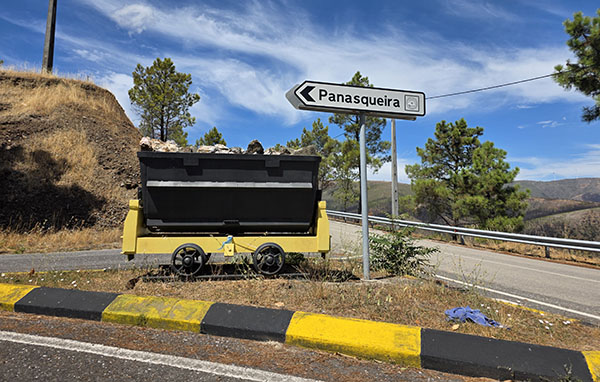
The location of the industrial plant compounded the problem. Barroca Grande was to become central to ore extraction and preparation, while the abundance of water beside the Zêzere favoured the establishment of the Rio dressing plant at Cabeço do Pião. Between them lay kilometres of difficult ground that ore, supplies and workers had to cross every day.
Meanwhile, wolfram itself was becoming increasingly important economically.
Working of the Panasqueira deposits began in the late nineteenth century and entered a new phase in 1911, when the mining interests passed to the British-owned The Wolfram Mining and Smelting Company Limited. Demand generated by the First World War brought fresh investment, while during the Second World War both output and employment reached an unprecedented scale.
In 1943 the company directly employed 5,790 workers, joined by 4,780 people engaged in the so-called quilo workings. More than ten thousand people were then involved in various ways in an operation whose product had acquired immense strategic importance.
Moving hundreds of thousands of tonnes across terrain of this kind required far more than manpower, animals and dirt roads.
A genuine industrial transport chain gradually took shape, combining mine railways, animal traction, aerial ropeways and, later, road vehicles. Within that chain, rail progressively became the backbone for moving ore, waste rock, supplies and people.

2. From miners’ muscle to mule trains
In the earliest years, transport began almost exactly where the miner’s work ended.
Handbarrows, baskets and wheelbarrows provided the most elementary means of movement. As stoping became more organised, so-called rail haulage appeared, using small wooden tubs capable of carrying heavier loads through narrow underground passages.
Successive haulage levels were established along the vein planes and linked by passes and small transfer arrangements. One tub could discharge into another on a lower level, allowing haulage to follow the workings even where the irregular disposition of the veins made a continuous drive impossible.
For a considerable time these small tubs continued to rely on the workers themselves. They were loaded at the faces and pushed to the ore passes or transfer points. Even in the mid-twentieth century, wooden tubs survived in some workings alongside scrapers and other mechanical equipment.
Haulage changed in scale when the ore reached the main adits.
Wagons loaded at the stope passes were taken to the principal gathering points. From there the ore proceeded to the main ore passes and reached the train-marshalling stations, where individual tubs were assembled into trains for main-line haulage.
Photographs from the 1940s show this organisation clearly. In one, a long train loaded with vein material heads towards the loading bins. In another, taken at the mouth of the Galeria Geral, a mule leads a rake of wagons towards the surface plant.
The Galeria Geral was then the mine’s principal railway artery. It was approximately 1,680 metres long and reached the vein zone about 1,275 metres from the portal. Its average gradient was 0.62 per cent falling towards the entrance, assisting loaded trains on their outward journey.
Replacing animal traction with diesel or electric locomotives was considered at this stage. The performance achieved by the mules, however, justified keeping them in service.
The figures show that this was no rudimentary system.
In 1940/41, each mule worked an average of eight trains per shift, normally made up of eight wagons. Over a shift it covered about 23 kilometres and performed approximately 75 net tonne-kilometres.
That year, 32 mules worked the Galeria Geral. By 1943/44, the number had risen to 40.
At the busiest times, as much as 1,200 tonnes was carried in a single shift, using 18 mules underground and two on the surface.
None of this could function without its own organisation.
Loaded tubs were assembled at the gathering points and coupled to a brake wagon carrying the muleteer. The solution was characteristically pragmatic: a tub underframe was weighted with old crusher jaws. This ballast helped control the train on gradients.
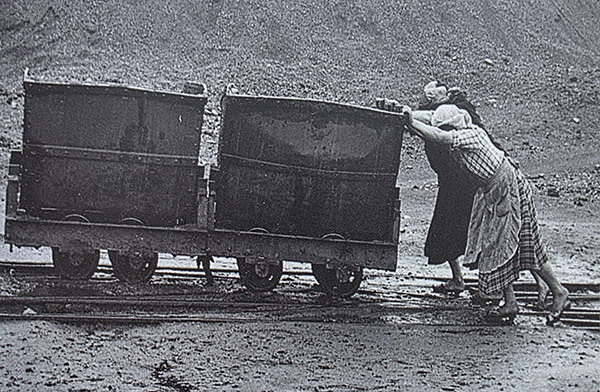
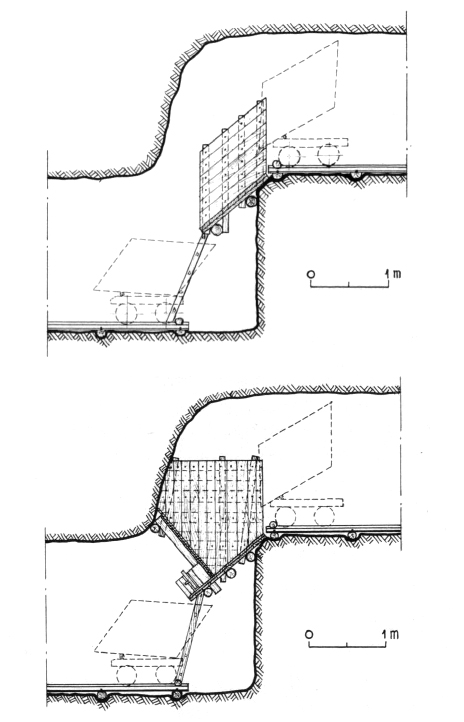


Shunting was also arranged to minimise idle time. A mule arriving at a marshalling station with an empty train could turn round and almost immediately take over a loaded rake. At the surface, wagons were emptied, remarshalled and sent underground again.
Not every load had the same destination. Ore went to the picking and treatment plant, while rubble and waste rock were sent to the tips. Some mules worked exclusively on the surface in this latter duty.
As the workings advanced beneath the mountain, the rails had to advance with them.
Panasqueira’s railway thus operated on two very different scales. Small tubs pushed by hand continued to work close to the faces. In the main adits, trains ran with marshalling stations, muleteers, coupling men, braking arrangements, shunting and organised traffic.
3. The 450 mm-gauge mine railway
During the 1940s, main haulage in the adits and around the Barroca Grande surface plant used a 450 mm-gauge railway.
The Galeria Geral had double track laid with 12 kg/m rail. Main-haulage rolling stock comprised 570-litre Hudson tipping wagons with wheelsets running in roller bearings.
The 450 mm gauge suited underground conditions at Panasqueira. Track could be installed in restricted-section drives, negotiate tight curves and be extended relatively easily as the workings advanced.
The railway did not end at the mine portal.
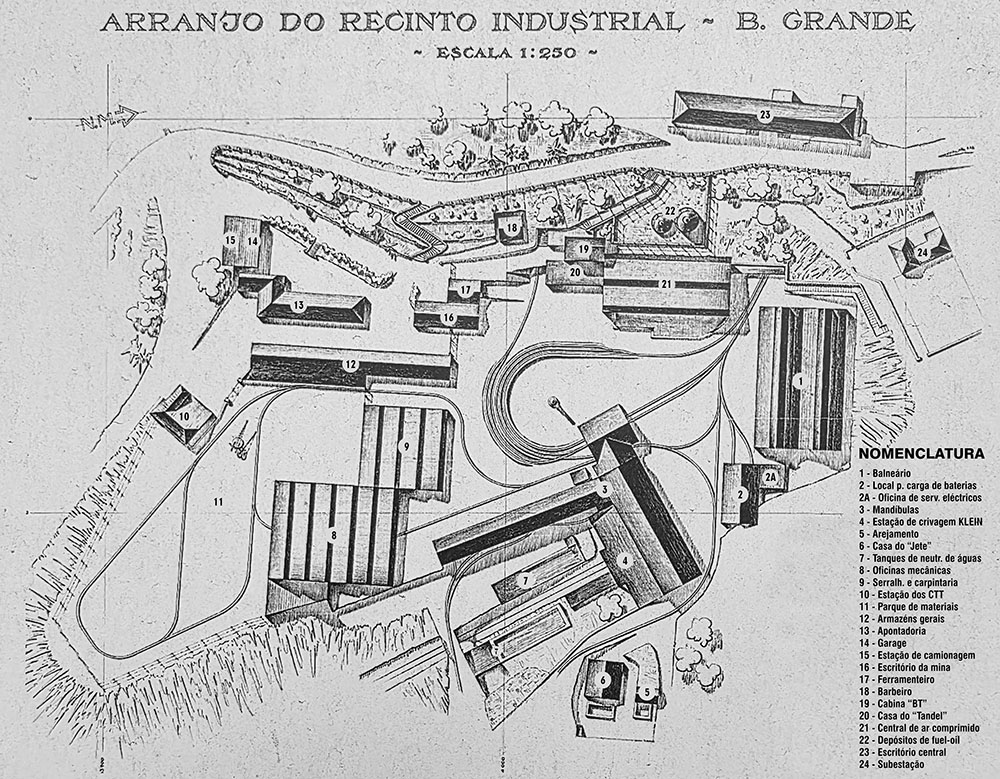
Rails extended across the yard and through the Barroca Grande plant, allowing tubs to reach the various receiving, picking and ore-preparation circuits directly. Waste rock travelled over other sidings to the tips, while empty wagons were remarshalled and returned underground.
Maintaining this stock required dedicated facilities. The building housing other mechanical services included a wagon repair shop, together with workshops for repairing rock drills and carrying out welding.
Thirty years later, in 1971, the mine railway still used 450 mm gauge and 12 kg/m rail, but its rolling stock and operating methods had been transformed.
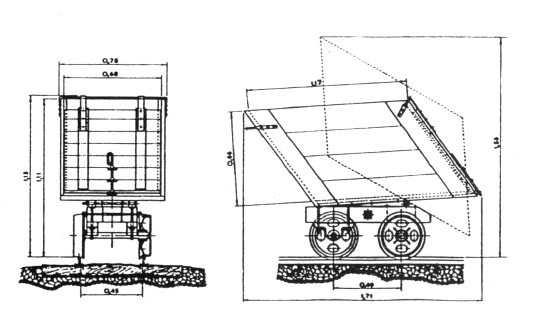
Wherever the layout of the workings allowed, track was arranged in one-way circuits. This avoided unnecessary conflicting movements, reduced the need for double track and improved both safety and traffic flow.
The rolling-stock fleet then included fixed-body Hudson wagons with a 1,360 kg payload and Hudson tipping wagons carrying 875 kg.
The historical photograph of the semi-automatic receiving plant at Barroca Grande, shown at the beginning of this article, conveys the scale of the infrastructure. A long rake of tubs occupies the plant tracks amid curves, sidings and pointwork. Vehicles used to carry the workforce can also be seen in the background.
The 450 mm-gauge railway thus connected the underground workings with the Barroca Grande surface plant, integrating the movement of ore, waste rock, supplies and workers in a single system.
4. From mules to locomotives
Animal traction had proved remarkably effective, but there was a limit to what it could achieve.
Output was rising, distances were growing and trains were becoming heavier. During the new expansion associated with the Korean War in the early 1950s, mechanisation accelerated throughout Panasqueira.
Hand-operated equipment progressively gave way to machinery. In main haulage, the most visible change was the gradual disappearance of the mules and the arrival of locomotives.
By 1971, small BEV battery-electric locomotives, particularly well suited to underground conditions, were working on the various mine levels. With 8 hp motors and 60-volt batteries, they could haul approximately 35 tonnes payload at about 6 km/h.
BEV stood for British Electric Vehicles, a British manufacturer of industrial electric vehicles. Locomotive production passed to Wingrove & Rogers in 1926, and that company retained the BEV name on later machines.
A BEV could haul 25 fixed-body Hudson wagons, each carrying 1,360 kg, for a total payload of about 34 tonnes. Alternatively, it could take 30 tipping wagons carrying 875 kg each, or approximately 26.25 tonnes.
On Level 0, where a substantial proportion of the ore converged before proceeding to the surface, the heaviest haulage was entrusted to Schöma diesel locomotives.
Rated at 32 hp, these machines could haul around 70 tonnes and reach a maximum speed of 8 km/h. A normal train could comprise as many as 50 fixed-body Hudson wagons, roughly twice the load normally entrusted to a BEV.
Operating diesel engines underground required additional precautions. The locomotives had exhaust-gas scrubbers to reduce the effects of combustion in the confined atmosphere of the workings.
Mechanisation brought locomotives of several origins and types to Panasqueira. BEV electrics handled much of the traffic on the various levels, while Schöma diesels worked the heavier duties. The fleet also included machines from Britain’s Ruston & Hornsby and Germany’s DIEMA, illustrating the variety of equipment used on the mine railways.
Preserved at Panasqueira is a Ruston & Hornsby Size 20, class DLU, works number 323559. A locomotive built by Diepholzer Maschinenfabrik F. Schöttler, the manufacturer known by the abbreviation DIEMA, also survives.

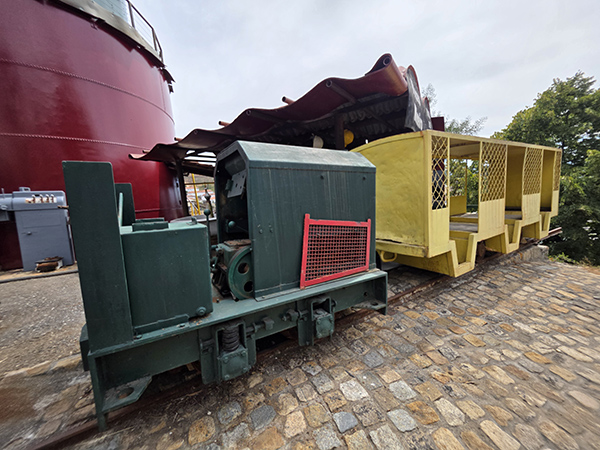
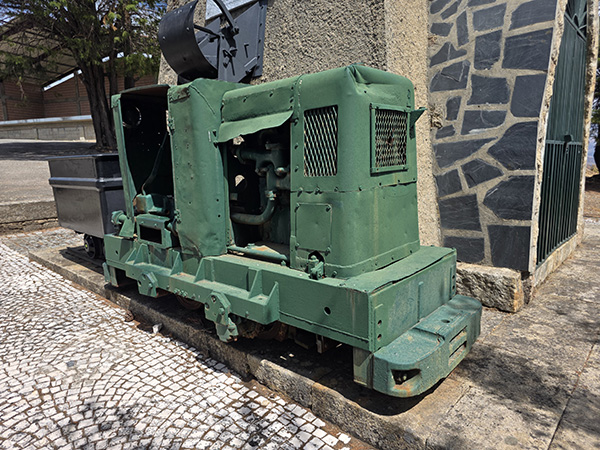
Despite the similarity between their names, DIEMA and Schöma were separate manufacturers. Christoph Schöttler left the family firm Diepholzer Maschinenfabrik in the late 1920s and established, also in Diepholz, the works that would use the Schöma name.
With the introduction of electric and diesel locomotives, the railway retained its essential function but began to move much larger and heavier trains. The system had reached a scale that animal traction could no longer sustain.
5. Ore out; supplies and men in
Mechanisation changed the locomotives and increased train lengths. It did not, however, alter a fundamental principle of mine traffic: making use of movements in both directions.
Before the ore could begin its journey, the tubs had to be loaded.
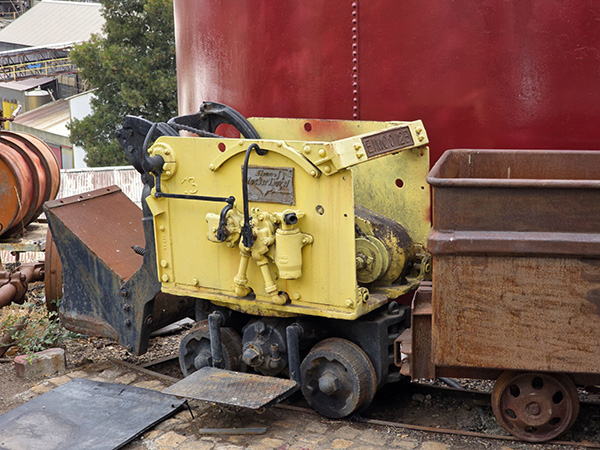
At the faces, an Eimco Rocker Shovel 12B gathered the broken rock and loaded it into wagons. This compressed-air, rail-mounted machine advanced into the muck with its bucket lowered. Once full, the bucket travelled over the machine and discharged directly into the tub standing behind it.
An example preserved at Panasqueira retains its Eimco Rocker Shovel plate, the model designation 12B and the number 13 marked on its frame. It records the mechanisation of a task previously performed by direct manual effort.
Once the tubs had been loaded and trains marshalled, the ore travelled to the principal receiving and treatment points. On the return journey, wagons did not necessarily run empty.
Inward workings were used to supply the various parts of the mine. The same railway that carried output away brought timber, tools, pipes, spare parts, explosives and much of what the underground workings required in the opposite direction.
When a load was too large for ordinary wagons, special flat trucks were used to carry bulky materials and equipment.
The mineworkers themselves also became railway traffic.
Metal coaches seating 12 men, hauled by locomotives, were used between the surface and the more distant workplaces. One such vehicle is still preserved at the mine.
The use of BEV locomotives required infrastructure that had not existed in the days of the mules.
Each level had battery-charging facilities equipped with LEGG rectifiers. Locomotives and batteries were also maintained there. The charging stations thus became vital centres in the railway’s daily operation.
On the surface, the railway was integrated directly into ore preparation. Trains entered the Barroca Grande receiving plant, where tubs were distributed among the various tracks and routed to the discharge points.
This direct connection between the railway and the treatment plant already existed in the 1940s.
In the original arrangement, wagons discharged ore at rail level directly into small bins above the feeders. Later, a compressed-air winch hauled them up an incline, allowing discharge into larger-capacity bins.
The railway did not, therefore, end when a train reached the surface.
The rails themselves entered the industrial circuit, carrying ore, waste rock, supplies and workers between the underground workings and the plant where each load reached its destination.
It was a system designed to keep the mine continually in motion: ore out; supplies and men in.
6. Sixteen locomotives beneath the mountain
By the beginning of the 1970s, Panasqueira’s railway had reached a considerable scale.
The 1971 survey recorded 13 battery-electric locomotives and three diesel locomotives distributed among the working levels. A total of 16 machines handled underground haulage.
The system was designed to move about 300 tonnes of ore per hour.
In 1970, the locomotives carried 557,280 tonnes of ore, representing 1,217,810 tonne-kilometres. The relationship between these figures indicates an average journey of about 2.2 kilometres per tonne.
Average electrical energy consumption was 0.45 kWh per tonne carried.
A comparison with the mule era conveys the extent of the system’s transformation.
In 1940/41, a railway still dominated by animal traction had moved 800,200 tonnes of ore and waste rock. Thirty years later, it was mechanised, worked by electric and diesel locomotives and integrated into a profoundly different mining operation.
The two figures cover different categories of traffic, but show the scale of rail haulage at two key points in the mine’s history. Despite successive technical changes, the railway remained indispensable to Panasqueira’s operation.
7. From 450 to 750 mm gauge
Rising output, increasing distances and the use of ever heavier trains eventually placed the infrastructure itself under pressure.
The 450 mm gauge, suited to the older workings and light rolling stock, was beginning to restrict the capacity of the principal haulage routes. Modernising the mine required larger wagons, more powerful locomotives and track capable of bearing much heavier axle loads.
The main haulage levels were converted to 750 mm gauge. 12 kg/m rail gave way to 26 kg/m sections, strengthening the track and allowing heavier rolling stock to operate.
The former wagons, with payloads of around 1.36 tonnes, were replaced by vehicles carrying 4 tonnes. Including tare, each wagon weighed approximately 6 tonnes.
The locomotives grew as well.
The small BEVs, weighing about two tonnes, were followed by 5.5-tonne trolley-wire electric locomotives and, later, diesel machines weighing as much as 12 tonnes.
This transformation kept rail at the heart of the extraction system even as other mine operations came to depend on rubber-tyred equipment, internal shafts and belt conveyors.
In 2016 Panasqueira had four principal levels, interconnected by ramps. Rail haulage was concentrated on two main haulage horizons: Level 2 at an elevation of 560 metres, and Level 3 at 470 metres.
Ore from the stopes descended through vertical passes 1.8 metres in diameter. At their foot, chutes allowed it to be loaded directly into 4-tonne self-discharging wagons.
On Level 2, overhead electric and diesel locomotives hauled the wagons to the pass feeding the underground crusher, installed below that level at an elevation of approximately 530 metres.
Ore from areas below Level 2 followed a different route. Once loaded into wagons, it was carried along Level 3 to the internal shaft providing the vertical connection with the level above.
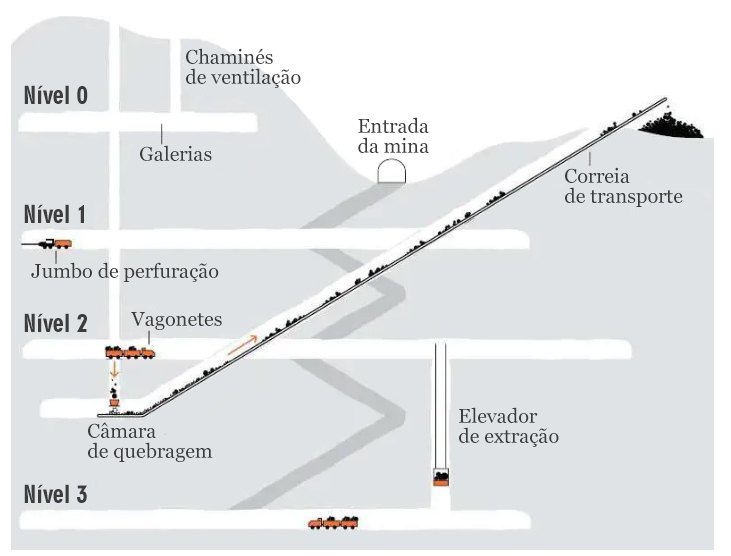
This shaft, about 90 metres deep, had a 284 kW winding engine. The complete system, incorporating automated wagon handling, entered service in April 1998.
Level 3 wagons were raised individually to Level 2. Once removed from the shaft, they returned to the rails and proceeded to the ore pass, where they discharged automatically to the underground crusher.
From that point onwards, a different transport system took over.
After crushing, the ore was transferred to the belt conveyor in the Santa Bárbara Ramp. 1,203 metres long and set at a 17 per cent gradient, the conveyor carried it to the surface.
The conveyor discharged into four large coarse-ore bins: three beneath the office building and another in front of it.
This formed a continuous chain: vertical passes brought ore from the stopes to the haulage levels; 750 mm-gauge trains carried it to the shaft or crusher; and the Santa Bárbara Ramp conveyor completed the ascent to the Barroca Grande plant.
Almost a century after the first wooden tubs, Panasqueira’s main haulage still depended on rail. Gauge, wagons, locomotives and other equipment had changed profoundly, but the railway retained its essential role as an artery of the underground mine.
8. Cabeço do Pião: steam locomotives beside the Zêzere
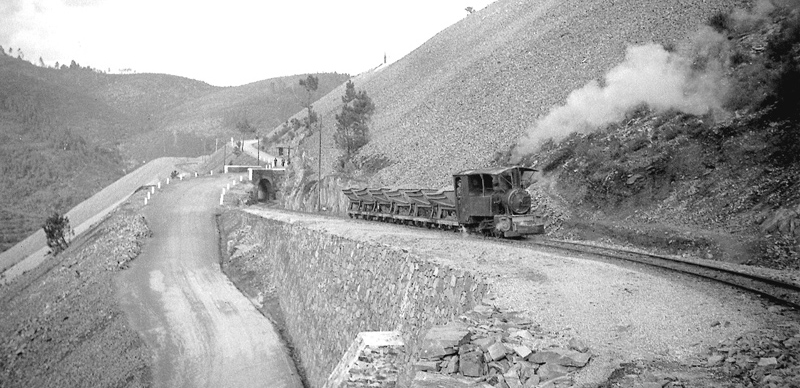
The Barroca Grande mine system was not the only railway built at Panasqueira.
A few kilometres away beside the Zêzere, an entirely different problem arose. At the Rio dressing plant in Cabeço do Pião, the task was no longer to remove ore from underground, but to carry enormous quantities of tailings away from the treatment plant.
Once again, the answer ran on rails. A separate line was built there, independent of the Barroca Grande mine railway and intended to carry tailings from the dressing plant.
Abundant water made Cabeço do Pião particularly favourable for mineral processing. The site had one disadvantage, however: there was insufficient space beside the plant to continue accumulating the large quantities of tailings it produced.
In 1941, material previously removed by hand began to be carried by mules.
The following year it became necessary to move the tailings to a new disposal site between 1 and 2 kilometres from the plant. Over that distance and for the volumes involved, animal traction no longer offered sufficient capacity.
An industrial railway was therefore built.
Wartime import difficulties led the company to acquire in Portugal two 60 hp steam locomotives and 12 wagons of 2.5 m³ capacity.
The line was built to 750 mm gauge with 20 kg/m rail.
Although it used the gauge later adopted on the mine’s principal levels, the Cabeço do Pião railway was an independent system. Built at a different time, it served different plant and existed solely to handle tailings from the dressing works.
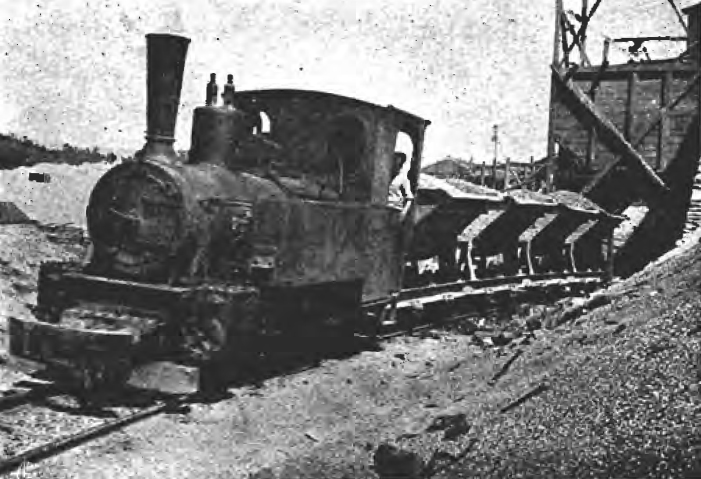
A photograph published in 1945 preserves one of the most evocative views of this railway. Captioned ‘Locomotive hauling tubs loaded with sand’, it shows a small steam locomotive at the head of several wagons in the Rio complex.
That ‘sand’ was the residue of mineral processing. Once wolfram and other recoverable mineral concentrates had been separated, the tailings had to be removed from the plant and carried to the disposal areas.
The photograph thus records the duty for which the line was built: the locomotive hauled loaded wagons from the Rio dressing plant to tipping areas established along the hillside.
The railway therefore handled the final stage of mineral movement at Cabeço do Pião. Before the tailings could reach the disposal areas, however, the raw ore first had to descend from Barroca Grande to the dressing plant in the Zêzere valley.
9. Between Barroca Grande and Rio
Before the tailings could be sent to the disposal areas at Cabeço do Pião, the raw ore had to reach the dressing plant by descending from Barroca Grande to the Zêzere valley.
Rail dealt with much of the movement within the mine and its industrial plant, but could not efficiently overcome every obstacle imposed by Panasqueira’s terrain.
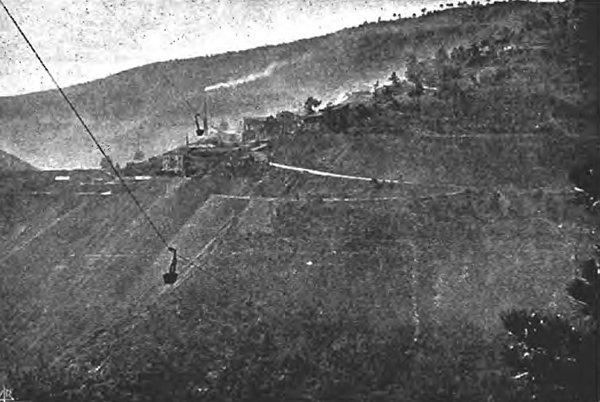
Between Barroca Grande and the Rio dressing plant, the answer was to leave the ground.
The ore began to fly across the mountain.
In the 1940s, the principal aerial ropeway between the two complexes was approximately 4,150 metres long and passed through an angle station at Entroncamento. Its continuous circuit used about 8,652 metres of cable.
The system also included a 300-metre section between Alvoroso and Entroncamento and another measuring 2,060 metres between Panasqueira and Barroca Grande.
The main ropeway overcame a height difference of 214 metres. Its 100 buckets, spaced approximately 82.5 metres apart, normally carried 330 kg of ore and travelled at around 139 metres per minute.
The system’s nominal capacity was 33 tonnes per hour, although operating records indicate an actual average of 34.52 tonnes per hour. During the busiest periods, some buckets carried nearly 360 kg.
At Barroca Grande, the bins serving the aerial ropeway could hold a total of 870 tonnes, providing a buffer between mine output and transport capacity to Rio.
The ropeway’s capacity made it necessary to select carefully the material sent to the dressing plant. Every tonne of waste rock loaded into the buckets displaced a tonne of economically valuable ore.
In 1943, a hand-picking plant was installed at Barroca Grande. Material from the mine passed over two picking belts, each 65 metres long and 0.75 metres wide, running at 10 metres per minute.
Together, the two belts could handle approximately 100 tonnes per hour.
Workers removed part of the waste rock as the material travelled along the belts, before the ore reached the aerial ropeway. Rejected material accumulated in bins with a total capacity of 350 tonnes and was then discharged into wagons. Recoverable ore entered the buckets and descended to the Rio dressing plant.
Hand picking therefore made better use of ropeway capacity and avoided carrying large quantities of uneconomic material down the mountain.
Ore reached Barroca Grande in trains from the mine and passed through the picking plant. Once part of the waste rock had been removed, it travelled in ropeway buckets to the Rio dressing plant. There it was processed into concentrate, while the tailings were loaded into wagons on the Cabeço do Pião railway and carried to the disposal areas.
At Barroca Grande, the railway delivered ore to the picking plant. The aerial ropeway then carried it to the Zêzere valley, overcoming the 214-metre height difference between the two complexes in a little over four kilometres. At Rio, the final stage began: ore treatment and the removal of tailings by the Cabeço do Pião railway.
10. A railway history hidden beneath the mountain
The history of Panasqueira’s railways mirrors the transformation of the mining operation itself.
The small tubs pushed by miners developed into an organised transport system with mule trains, marshalling stations, brake wagons, workshops and workers specialising in tracklaying and maintenance.
Mechanisation brought electric and diesel locomotives, higher-capacity wagons and coaches for the workforce. The former 450 mm-gauge railway was converted to 750 mm and continued to carry ore between the stopes, the main haulage levels, the internal shaft and the underground crusher.
On the surface, the aerial ropeway connected Barroca Grande with the Rio dressing plant. At Cabeço do Pião, two steam locomotives carried tailings to disposal areas beside the Zêzere.
Panasqueira thus brought different forms of transport together in a single industrial chain, adapted to the mountain geography and the requirements of each period.
For decades, the rails were among the mine’s principal arteries. Ore travelled out over them, supplies went in and mineworkers rode to their workplaces. Without the railway, the scale achieved at Panasqueira would scarcely have been possible.
Bibliography
ALLAN, J. C.; SMITH, G. A.; LEWIS, R. I. — ‘As minas da Panasqueira — Exploração e tratamento de minério de volfrâmio’, Revista da Ordem dos Engenheiros, continuation consulted, pp. 508–529. The original study was published in English as ‘The Panasqueira Mines, Portugal; Wolfram Mining and Milling; Labour Organization’, Transactions of the Institution of Mining and Metallurgy, nos. 481–482, 1947, pp. 31–48.
AMERICAN SOCIETY OF MECHANICAL ENGINEERS — ‘EIMCO Rocker Shovel Loader, Model 12B’, Historic Mechanical Engineering Landmark, no. 212. Available from: ASME. Accessed 24 August 2026.
BARROQUEIRO, M. L. Gaspar — ‘O “Projecto Rio” e o Património Geomineiro das Minas da Panasqueira’, Actas do 3.º Simpósio sobre Mineração e Metalurgia Históricas no Sudoeste Europeu, 2005, pp. 49–62.
CORRÊA DE SÁ, A.; NAIQUE, R. A.; NOBRE, Edmundo — ‘Minas da Panasqueira: 100 anos de história mineira’, Boletim de Minas, vol. 36, no. 1, January–March 1999, pp. 3–22.
LEAL, Father Manuel Vaz — As Minas da Panasqueira. Vida e História. 1945. Reprint: Câmara Municipal da Covilhã / Junta de Freguesia de Aldeia de São Francisco de Assis, Covilhã, 2004.
MELLO MENDES, F. — ‘Os antigos métodos de desmonte das Minas da Panasqueira’, Boletim de Minas, Lisbon, vol. 30, no. 4, October–December 1993, pp. 329–352.
REAL, João Pedro — A evolução técnica nas Minas da Panasqueira em 120 anos de actividade. Beralt Tin & Wolfram (Portugal), 2016.
REIS, António Cláudio dos — ‘As Minas da Panasqueira’, Boletim de Minas, Lisbon, vol. 8, no. 1, 1971, pp. 3–44.
THE COMMERCIAL MOTOR — ‘The Future of B.E.V. Trucks’, in ‘Wheels of Industry’, 21 September 1926, p. 38.
WHEELER, Adam — Technical Report on the Mineral Resources and Reserves of the Panasqueira Mine, Portugal. NI 43-101 report prepared for Almonty Industries, 31 December 2016.
Comments
Leave a comment
Your comment will remain pending until it has been moderated.
There are no approved comments for this article yet.