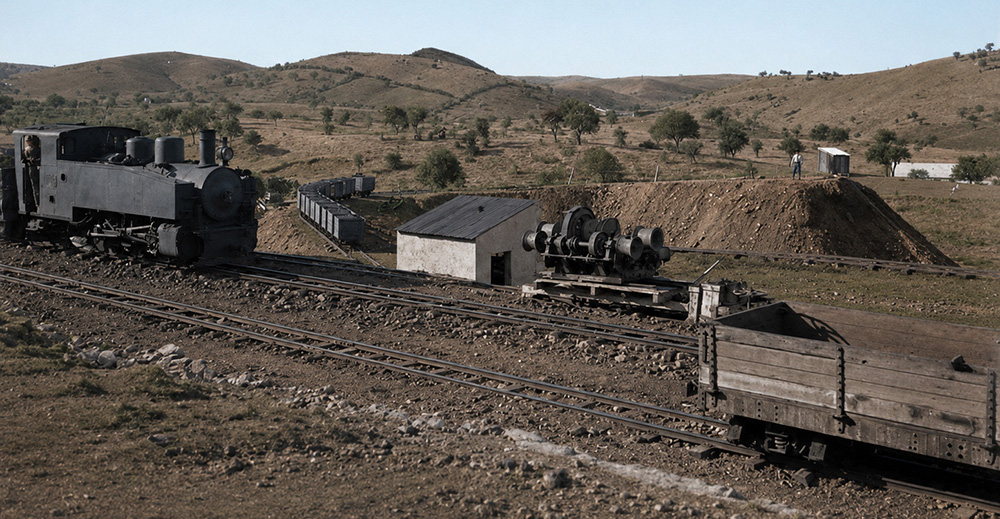
For many years, anyone examining certain maps of Portugal could find, in the heart of the Alentejo, a small railway that no longer existed on the ground. It ran from the Santa Susana coal mines, crossed hills and landed estates, and ended beside the South and South-East main line at a place known simply as Cais 78.
It comprised just over sixteen kilometres of narrow-gauge track, far from any important settlement. Even so, thousands of tonnes of coal, hundreds of workers and two very different steam locomotives passed over it: one German, built specially for the undertaking and bearing the inscription ORDEM; the other American, its origins still shrouded in mystery.
Today, almost everything has vanished. What remains are scattered documents, photographs, traces on the ground and the memories of people who, as children, watched those little trains cross the Alentejo landscape.
This is the story that can still be reconstructed.
Coal in the Alentejo
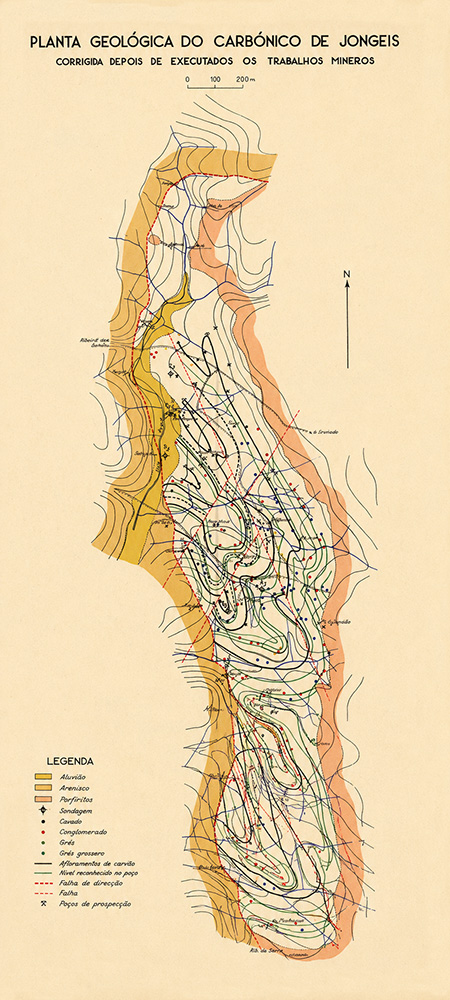
The Santa Susana coalfield, also known as the Moinho da Ordem district, comprised several outcrops of continental coal. The most important lay at Jongeis, Remeiras and Vale do Burro.
The Vale do Burro outcrop was marked by Carlos Ribeiro on the 1876 geological map. Wenceslau de Lima later studied the district and published new mapping in 1899. In 1918 and 1919, the Portuguese Government authorised the Lisbon firm Manuel Vicente Ribeiro, Limitada, to carry out prospecting under the on-site direction of the engineer Carlos Freire de Andrade. The mining concession was granted to the same company on 20 October 1922.
The earliest work was concentrated chiefly at Vale do Burro. Galleries, trenches and trial pits were opened, but the results failed to meet expectations. The coal occurred in irregular seams, frequently disrupted by faults and mixed with other material.
The situation began to change when prospecting moved northwards towards the Jongeis estate. Investigations revealed more promising conditions there, and it was in this area that the principal colliery would eventually be developed.
A British company to work the concession
In 1925, a British company formed specifically to work the Santa Susana coal deposits entered the scene.
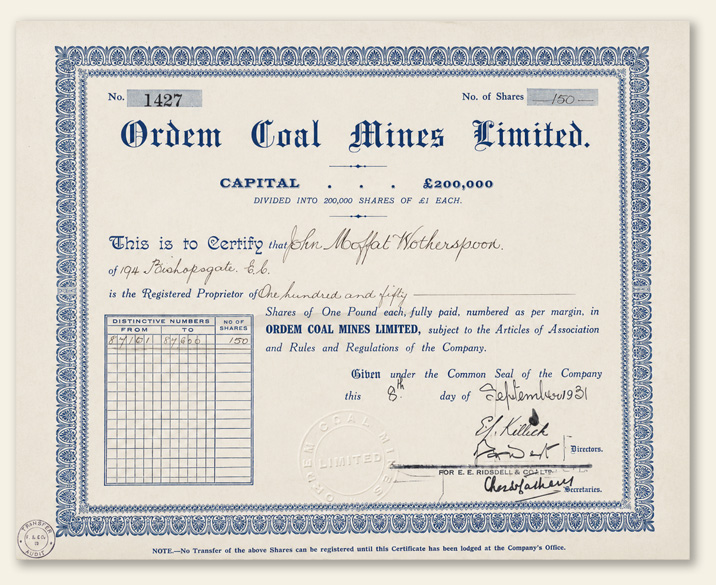
The Ordem Coal Mines Limited was incorporated in London on 19 May 1925 with an initial capital of £50,000, divided into 50,000 one-pound shares. Its articles empowered it to work mines, build railways, acquire machinery and undertake all activities required for the transport and sale of coal.
A few days later, on 2 June, the company formally acquired the rights associated with the Portuguese concession. The total consideration was fixed at £35,000, paid in shares in the new company and divided between the Portuguese State, Manuel Vicente Ribeiro, Limitada, and the London Financial Trust.
The capital was subsequently increased, reaching £200,000 at the beginning of the 1930s.
The venture was ambitious. Its purpose was not merely to continue small-scale prospecting, but to establish an industrial undertaking capable of producing coal in quantity and placing it on the market.
The State was also a shareholder
The transaction had an unusual feature: the Portuguese State became a shareholder in the British company. Part of the consideration for transferring the mining rights was paid in shares in The Ordem Coal Mines Limited, leaving the State with a holding of almost five per cent of the initial capital.
The Treasury followed the company’s affairs, received reports and accounts, and was represented at shareholders’ meetings. The holding, however, appears never to have yielded a dividend and ultimately shared in the company’s long sequence of financial difficulties, liquidation and transfer of the concession.
The move to Jongeis
In 1927, mining activity was transferred from Vale do Burro to Jongeis, where the concession’s principal colliery would be developed. New shafts, galleries and supporting installations were opened there.
Growth was rapid. In 1926, the mining works employed about 220 people. By 1928, the workforce had risen above four hundred and, in 1931, reached 499. Output expanded with it, although with substantial fluctuations from year to year.
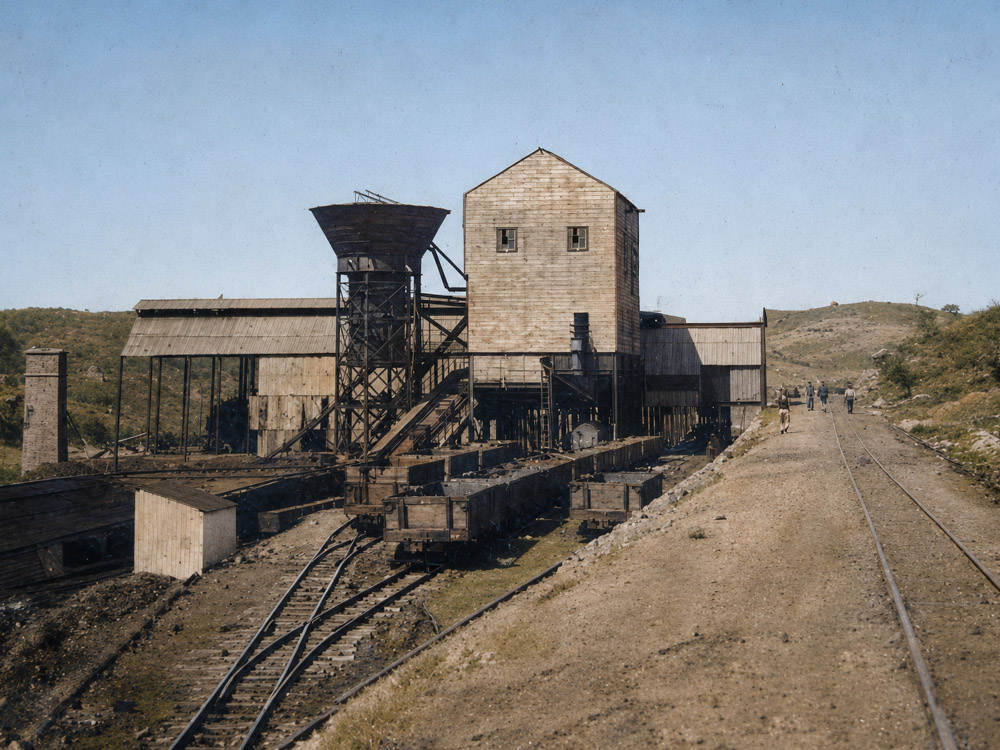
The mine complex came to include housing for workers and technical staff, workshops, a washery, electrical plant, compressors, steam engines and an extensive internal network for mine tubs. The tracks ran both underground and on the surface, connecting galleries, shafts and coal-treatment installations.
The undertaking nevertheless faced a problem that increased output alone could not solve: transporting the coal.
The mines lay far from the stations at Alcácer do Sal and Casa Branca. The roads were poor, and road haulage, with its limited capacity and low speed, was slow and made the product excessively expensive. Without a railway of its own, the undertaking could scarcely compete with imported coal.
The answer had to be a colliery railway.
A 600 mm-gauge railway
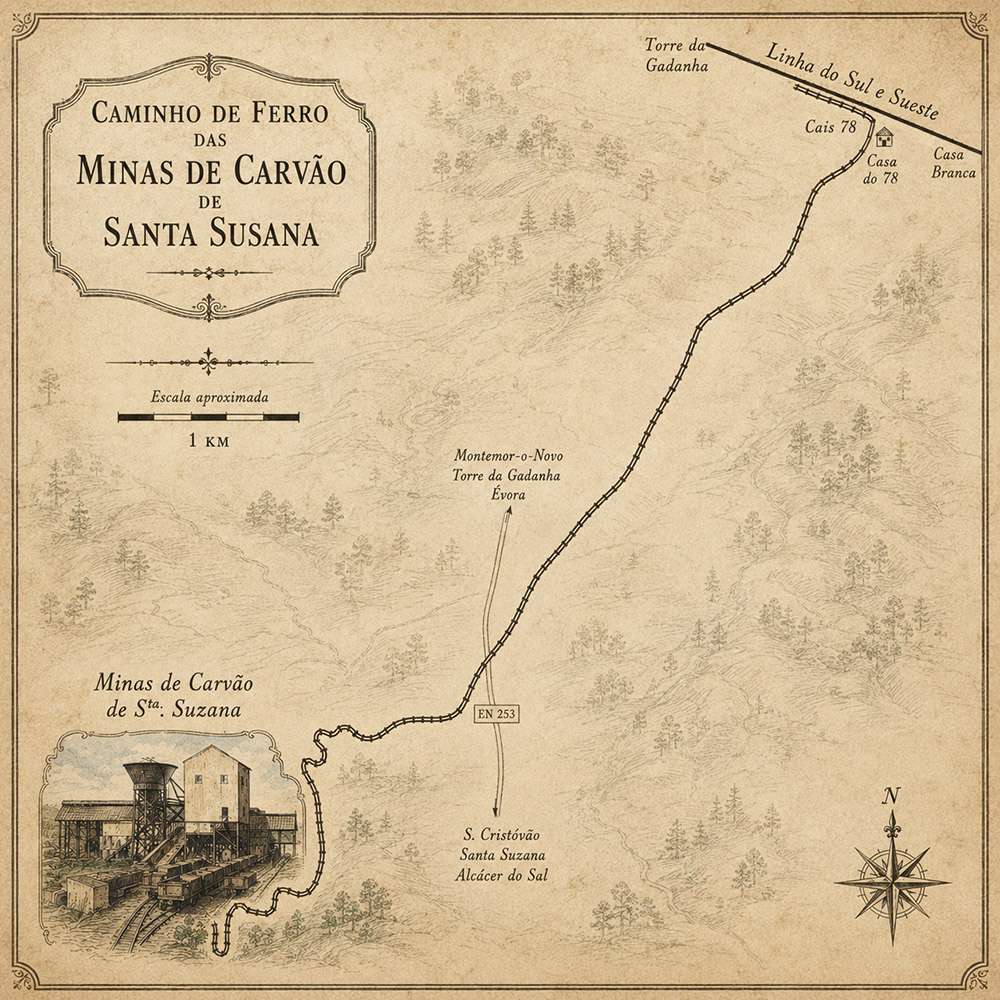
On 2 March 1927, the Government authorised the Ordem Coal Mines company to build and operate a narrow-gauge railway between the mines and the South and South-East main line.
The licence specified a gauge of 600 millimetres and an official length of 16,050 metres. The route began in the Moinho da Ordem mining district and ended beside the main line near Torre da Gadanha.
The Gazeta dos Caminhos de Ferro reported the concession, describing it as a mineral railway intended to connect the coal workings with the broad-gauge South and South-East network.
Construction proceeded quickly. A report by the Directorate-General of Railways records that, when surveys began in December 1927 for a proposed railway between Casa Branca and Alcácer do Sal, the Jongeis mines had already built a narrow-gauge railway towards Torre da Gadanha.
The existence of this connection even led the engineers to abandon the original idea of routing the proposed public railway through the mines. They instead studied an alignment by way of Casa Branca, Caeirinha and Santa Susana.
Designed for industrial traffic and built on essentially economical principles, the railway followed the contours and avoided major engineering works. In the first part of the route, where the ground was more broken, the line wound between hills and valleys; farther on, across flatter country, long straight sections followed one another. Between its termini, the railway overcame a height difference of more than 120 metres and approached Cais 78 through a sharp-radius curve.
Provisional opening in May 1928
On 10 May 1928, a commission was appointed to inspect the railway. Its examination identified work still requiring correction and maintenance, but the accumulation of coal at the mines made the beginning of transport urgent.
The line was therefore authorised to open provisionally on 31 May 1928. This designation indicates that traffic began before all the work required by the commission had been completed.
From that point onwards, however, the railway fulfilled the purpose for which it had been built: carrying coal from Jongeis to the interchange with the broad-gauge network.
Cais 78
The terminal became known as Cais 78 because it stood near kilometre 78 of the South and South-East main line.
Two railways of entirely different character met there. The 600 mm-gauge colliery line arrived from the mines, while a private broad-gauge siding connected the site with the national network.
This siding joined the South and South-East main line at kilometre 77.497 and was governed by Instruction No. 2150 of the Companhia dos Caminhos de Ferro Portugueses, dated 15 September 1928.
The function of the terminal was simple but essential. Coal arrived in the mineral wagons of the colliery railway and was transhipped into broad-gauge wagons, before continuing over the national network.
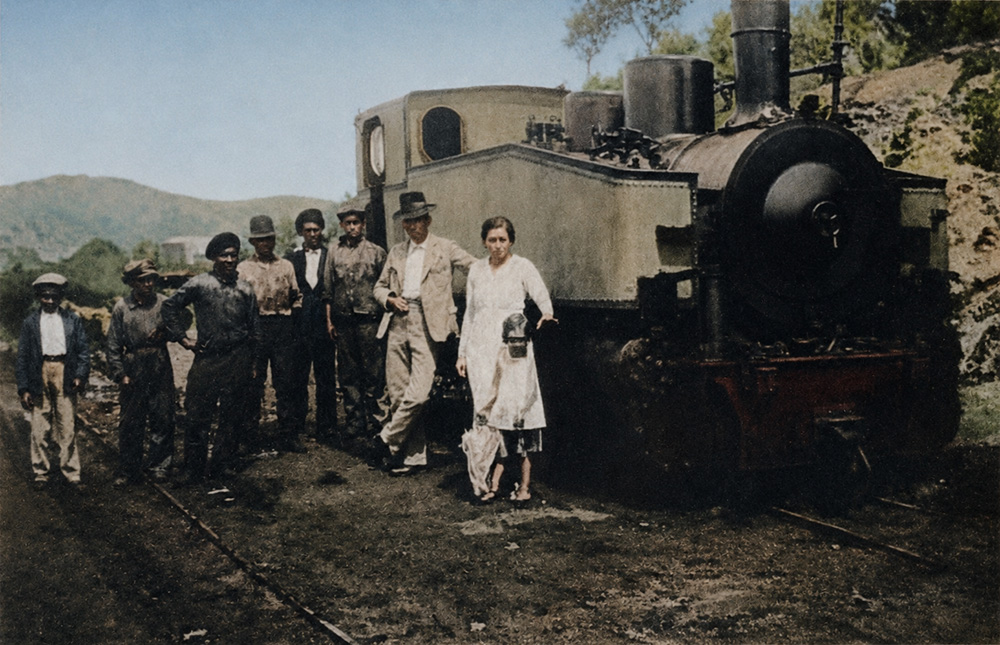
One of the surviving photographs shows this very location. The ORDEM locomotive stands in the centre, with bogie mineral wagons. Around it can be seen workers, rudimentary installations and the open Alentejo landscape.
Cais 78 was not a station in the usual sense. It handled no passenger traffic and was not open to the public. It was an industrial transhipment point created solely for the mine, yet it became the hub of the entire transport system.
ORDEM, the principal locomotive
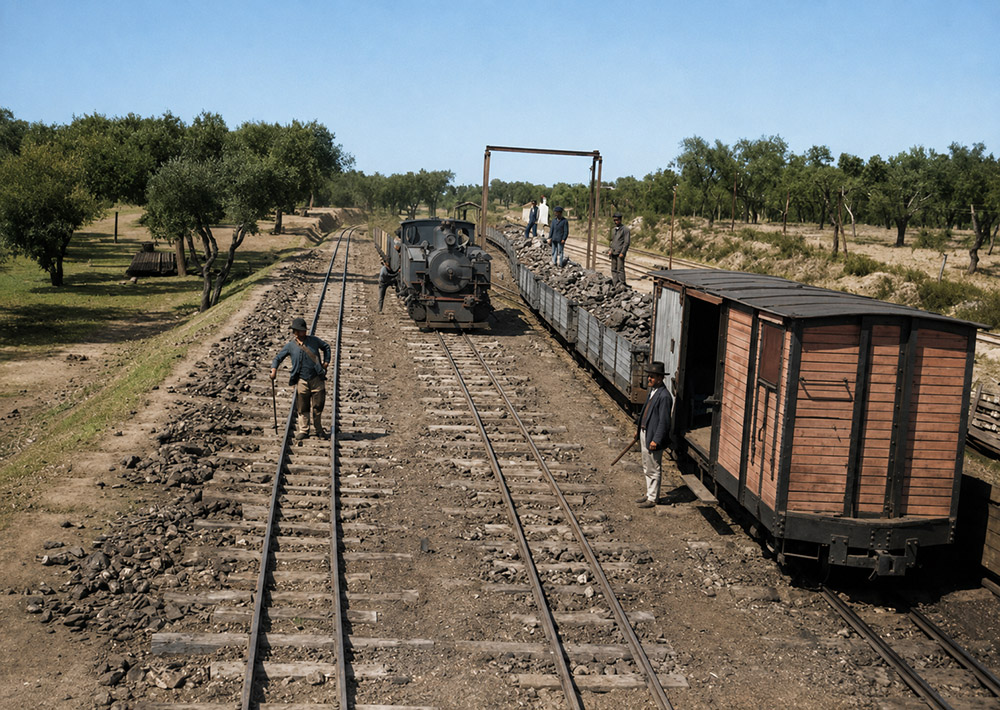
The railway’s principal locomotive was built in 1927 by Berliner Maschinenbau AG, formerly Schwartzkopff. It carried works number 9135 and was delivered on 13 October that year to the Minas de Carvão da Ordem in Portugal.
It was a 600 mm-gauge tank locomotive with three coupled driving axles and a trailing carrying axle. Its C1 axle arrangement in German notation corresponded to 0-6-2T in the British Whyte classification.
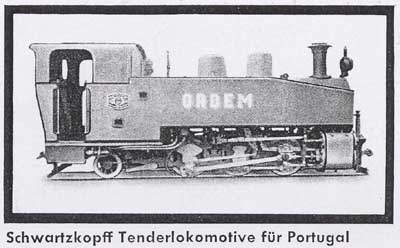
In the builder’s photograph, the locomotive bore the clearly visible inscription ORDEM on its side tanks. This may have identified the colliery or company for which the engine was intended, although it may also have served as the locomotive’s name. The inscription cannot be seen in the other known photographs taken in service, and no running number allocated by the company has been identified. The available images suggest that the locomotive’s livery changed during its working life.
Data published by Transportes Mundiais
| Characteristic | Value |
|---|---|
| Gauge | 600 mm |
| Overall length | 6.50 m |
| Overall width | 2.00 m |
| Height to chimney top | 2.76 m |
| Stated power | 70 hp |
| Boiler pressure | 12 kg/cm² |
| Approximate weight | 20 t |
Builder’s data
| Characteristic | Value |
|---|---|
| Builder | Berliner Maschinenbau AG / Schwartzkopff |
| Works number | 9135 |
| Year built | 1927 |
| Delivery date | 13 October 1927 |
| Gauge | 600 mm |
| Wheel arrangement | C1 / 0-6-2T |
| Cylinder diameter | 320 mm |
| Piston stroke | 400 mm |
| Driving-wheel diameter | 800 mm |
| Fixed wheelbase | 1.90 m |
| Total wheelbase | 3.50 m |
| Boiler pressure | 12 kg/cm² |
| Grate area | 0.91 m² |
| Heating surface | 45.8 m² |
| Weight empty | 17.2 t |
| Weight in working order | 22.8 t |
| Adhesive weight | 19.0 t |
| Water capacity | 2.3 m³ |
| Coal capacity | 1.2 t |
The figures given by the two sources do not agree in every respect. The most obvious discrepancy concerns power: the BMAG delivery list assigns the locomotive 150 hp, whereas Transportes Mundiais gives 70 hp. This difference cannot yet be explained and may reflect different criteria for rating or measuring the locomotive’s output.
The builder’s photograph and the images taken at Moinho da Ordem show a substantial locomotive designed to work the principal trains between the mines and the South and South-East main line. On an industrial railway more than sixteen kilometres long, with significant gradients and sharp curves, its adhesive weight and its water and coal capacity were essential for hauling loaded trains over the full route.
The mysterious Baldwin
The second locomotive was smaller and remains the more enigmatic of the two engines used on the colliery railway. It had been built by the American Baldwin Locomotive Works, but its works number, original purchaser and precise type remain unknown, and no photograph has yet been found from which the model can be identified with confidence.
A document prepared in 1946 by Transportes Mundiais, Limitada, gives the following particulars:
| Characteristic | Baldwin |
|---|---|
| Builder | Baldwin Locomotive Works |
| Stated year built | 1927 |
| Gauge | 600 mm |
| Overall length | 5.50 m |
| Overall width | 2.00 m |
| Height, including chimney | 2.70 m |
| Stated power | 48 hp |
| Boiler pressure | 15 kg/cm² |
| Total number of axles | 5 |
| Approximate weight | 15 t |
It probably entered service in 1929. This date is suggested by the operating statistics: only one locomotive was still recorded in 1928, whereas in subsequent years the motive-power stock comprised two engines.
The stated construction year of 1927, by contrast, should be treated with caution. Although it appears in the 1946 documentation, a systematic examination of Baldwin production records for 1900–1930 has failed to identify any new 600 mm-gauge locomotive that can be associated with the Moinho da Ordem mine or The Ordem Coal Mines Limited. Nor has an order been found in the name of the company, its directors or any identifiable intermediary.
This absence of documentation, together with the stated characteristics, makes it quite plausible that the locomotive was acquired second-hand and that the 1927 date derived from information supplied by its owner, from a later administrative reconstruction or simply from an error.
One type that comes particularly close to the known data is the British military Baldwin 10-12-D, built in large numbers during the First World War for 600 mm-gauge field railways.
These were tank locomotives with a 4-6-0T wheel arrangement in Whyte notation: a two-axle leading bogie and three coupled driving axles, giving precisely the five axles mentioned in the Portuguese document. Their weight, overall dimensions and suitability for lightly laid railways with sharp curves also resemble the particulars attributed to the Santa Susana locomotive.
After the war, many 10-12-D locomotives left military service and were sold as surplus. Some remained in France and found a second life on agricultural and industrial railways; others went to mines, quarries, plantations and narrow-gauge systems in various countries. Their civilian use over several decades is well documented, notably on French sugar-beet railways and Bulgarian lines.
The possibility that one of these locomotives reached Santa Susana also fits the corporate background. The Ordem Coal Mines Limited was a British company incorporated in 1925, and at least one of its directors was connected with a wide network of mining, financial and engineering concerns. The company could therefore have obtained used industrial equipment on the British market or through dealers handling military surplus.
Even so, the identification remains hypothetical. Without a photograph, works number or other documentary proof, it cannot be stated that the Santa Susana locomotive was in fact a Baldwin 10-12-D.
The colliery wagons
Much less is known about the hauled stock than about the locomotives.
It has not been possible to determine the wagons’ origin, builders, acquisition date or total number. Some may have been purchased for the opening of the railway, but no documentation has been found to confirm this.
All available information therefore comes from analysis of the surviving photographs.
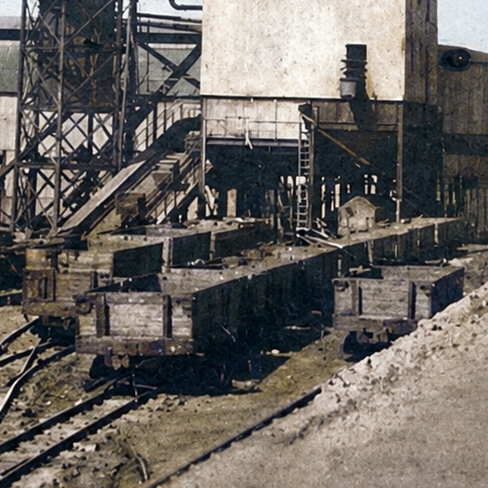
The images show open bogie wagons with wooden bodies and sides of varying height. Some had comparatively low sides, while others carried taller bodies, apparently produced by raising the side panels. Certain vehicles may have been altered in the colliery workshops, although this possibility is not documented.
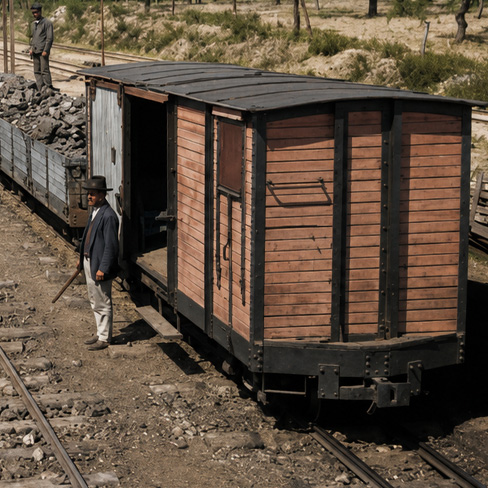
One photograph also shows a covered bogie van with a wooden body, sliding side door and small ventilation openings at the ends. Its exact purpose is unknown, but it was probably a service vehicle for the undertaking.
Another image includes a mechanical assembly mounted on a small railway platform, possibly a trolley or works wagon. The photograph does not allow either the equipment or its function to be identified with certainty.
No numbers, inscriptions or builder’s marks are visible from which the stock might be identified. The fate of the vehicles after the mine closed is likewise unknown.
Growth, crisis and fluctuating traffic
The undertaking’s early years were marked by rapid expansion. Output increased and traffic through Cais 78 grew with it.
In the series of terminal figures currently known, tonnage forwarded reached its maximum in 1931 at more than 31,000 tonnes. A sharp decline followed, associated with the economic crisis and the company’s financial problems.
These figures represent traffic recorded at Cais 78, not the colliery’s total output. The mining bulletins distinguished between run-of-mine coal, coal treated in the washery, sales, consumption by the undertaking itself and stocks held in store. The various series are therefore not directly comparable and do not always agree.
From 1932 onwards, the difficulties became evident. Directors’ reports recorded losses and argued for continuing operations on a reduced scale. The workforce, which had reached 499 in 1931, fell to 126 by 1934.
In the financial statements, the combined heading Railway, Rolling Stock and Motor Vehicles was valued at £21,035 in 1931 and £18,931 in 1932. It covered the railway, rolling stock and road vehicles, and the amount attributable solely to the colliery railway cannot be determined.
After the low levels recorded between 1934 and 1936, activity increased once more. In 1937, the mine again employed 483 workers and traffic through Cais 78 exceeded ten thousand tonnes. The bulletins for that year and 1938 continued to list two steam locomotives, engine drivers, firemen and staff engaged in maintaining the railway. In 1938, the combined coal consumption of the mine’s power plant and the railway reached 16,033 tonnes, confirming that rail transport remained fully integrated with the undertaking.
| Year | Coal forwarded through Cais 78 |
|---|---|
| 1927 | 619 t |
| 1928 | 2,851 t |
| 1929 | 15,921 t |
| 1930 | 19,124 t |
| 1931 | 31,730 t |
| 1932 | 23,549 t |
| 1933 | 9,479 t |
| 1934 | 1,201 t |
| 1935 | 1,956 t |
| 1936 | 819 t |
| 1937 | 10,576 t |
| 1938 | 11,039 t |
| 1939 | 12,596 t |
| 1940 | 6,835 t |
| 1941 | 16,567 t |
| 1942 | 9,070 t |
| 1943 | 1,079 t |
From the British company to São Pedro da Cova
The British company entered a creditors’ voluntary liquidation in 1933. By the following year, the concession was already recorded in the name of the engineer Geraldo Braamcamp de Mancellos, although this did not bring operations to an end.
The rights later passed to the Companhia das Minas de Carvão de São Pedro da Cova. The Santa Susana undertaking therefore went through several corporate phases: it began as a Portuguese initiative, was industrialised with British capital and was ultimately absorbed into one of the country’s most important coal-mining companies.
The railway and the lorries
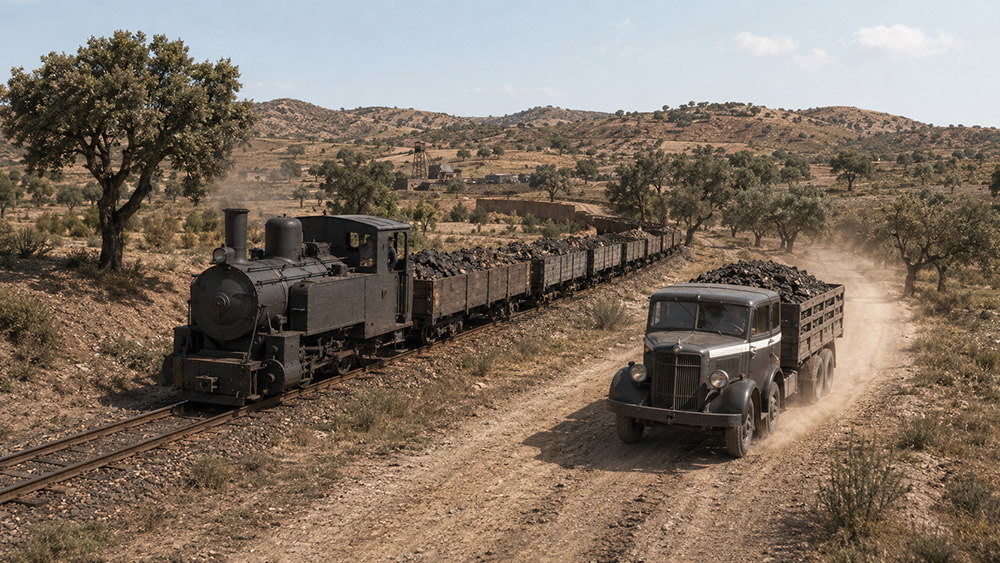
Testimony from José Cavaco Custódio, who worked at the mines in the late 1930s, recalls the use of lorries to transport coal. He did not remember seeing the external railway to Cais 78 in operation, although he retained a clear memory of the tubs used within the workings.
The official statistics nevertheless show that the railway remained active. In 1937 and 1938, the mine still had two steam locomotives, two engine drivers and two firemen. In the latter year, the workforce also included three platelayers, while the coal consumption of the mine’s power plant and the railway was recorded jointly.
Traffic through Cais 78 also recovered towards the end of the decade, exceeding ten thousand tonnes a year from 1937 to 1939. As the terminal had no direct road access, coal forwarded there must necessarily still have arrived over the colliery railway.
José Cavaco Custódio’s recollection therefore confirms that lorries formed part of the undertaking’s transport arrangements, but not that they replaced the railway. The two systems coexisted, performing functions and serving destinations that may have differed.
The war and the final effort
With the outbreak of the Second World War, the difficulty of importing fuel gave renewed value to Portuguese coal. Output at Santa Susana recovered in some years, although it never regained the stability seen at the beginning of the 1930s.
From March 1943, the entire output appears to have been allocated to the Companhia dos Caminhos de Ferro Portugueses. Heavily dependent on coal for its steam locomotives, the CP sought to exploit every available source.
In 1944, 36,802 tonnes of bituminous coal were still extracted, chiefly for railway services on the South and South-East system. In the same year, the area then being worked was judged exhausted.
Regular industrial working probably ended in 1944 or 1945. Prospecting for new reserves nevertheless continued, while the concession remained administratively active for several more years.
Two locomotives for sale
On 30 November 1946, Transportes Mundiais, Limitada applied for permission to export the mine’s two locomotives to Spain.
The engines were described as used but in good condition and ready for service. The company added that it had sought buyers in Portugal without success.
The Directorate-General of Railways raised no objection to the export. From that point onwards, the trail of both locomotives disappears.
ORDEM and the Baldwin may have gone to Spain and begun a second working life at a mine, quarry or industrial undertaking. It is equally possible that the sale was never completed.
The end of the railway
Manuel Agostinho Beleza dated the lifting of the track to about 1944 or 1945, coinciding with the end of regular industrial working. Soon afterwards, both locomotives were offered for sale.
The short broad-gauge siding remained in the records for longer. Its signalling instruction was not formally cancelled until April 1967, by which time the connection had long belonged to the past.
Everything suggests that the colliery railway was dismantled soon after closure, gradually disappearing from the landscape and from local memory.
What remained on the ground
When the site was visited in 2010, the broad-gauge siding had already disappeared.
Part of the transhipment-platform wall nevertheless survived, where coal had passed from the small mineral wagons into wagons of the national network.
Elsewhere, the course of the former railway could still be recognised, transformed into a rural track or absorbed by vegetation.
The mine houses and installations were in an advanced state of decay. Among the ruins, traces of coal scattered across the ground recalled the activity that had altered this landscape for about two decades.
At first sight, nothing suggested that a railway more than sixteen kilometres long had once existed there, with two steam locomotives, dozens of wagons, workshops, workers and a terminal connected to the South and South-East main line.
A story still incomplete
The main outlines of the history of the Moinho da Ordem colliery railway are now known.
We know when it was authorised, its gauge, its official length and the date of its provisional opening. We know Cais 78, the connection with the South and South-East main line, part of the coal traffic and the characteristics of both locomotives.
We also know that the undertaking did not simply end with the liquidation of the British company. The concession passed through the hands of Geraldo Braamcamp Mancellos, reached the Companhia das Minas de Carvão de São Pedro da Cova and remained administratively active for several years after the productive area was exhausted.
Several essential questions nevertheless remain unanswered. The Baldwin’s works number is still unknown. It is not known where the locomotive was acquired, when it arrived at Santa Susana or who its previous owner had been. Nor is there confirmation that the two engines actually went to Spain.
Perhaps a newly discovered photograph, a forgotten inventory or another witness will one day add a further chapter.
Until then, this story remains: that of a small colliery railway built to connect Alentejo coal with the rest of the country, and which for a few years carried the sound of steam and clattering wagons between Jongeis and Cais 78.
Sources and bibliography
Sources and bibliography: Arquivo Contemporâneo do Ministério das Finanças, file PT/ACMF/DGFP/RT/PES/0543; The National Archives, BT 31/32687/206070; Boletim de Minas, various years; reports of the Direção-Geral de Caminhos de Ferro, various years; Gazeta dos Caminhos de Ferro; Comunicações dos Serviços Geológicos de Portugal, vol. XXXVI, 1955; Adérito de Oliveira Sedas Nunes, ‘Notas sobre a Economia Portuguesa do Carvão’, Indústria Portuguesa, no. 251, January 1949; registers and specification books of Berliner Maschinenbau AG and Baldwin Locomotive Works; documentation of the Companhia dos Caminhos de Ferro Portugueses and Transportes Mundiais, Limitada; letter and oral testimony from Manuel Agostinho Beleza; testimony from José Cavaco Custódio; historical photographs and field observation.
Comments
There are no approved comments yet.