
Some railways are built with their end already in sight. Constructed to serve a specific project, they fulfil their purpose for a few years and disappear once the work is complete. Such was the fate of the small industrial railway built for the Pego do Altar Dam.
Virtually unknown outside the region, the line never formed part of any national railway scheme, had no connection with the public network and served one very specific purpose: carrying the stone required to build the dam, in the municipality of Alcácer do Sal.
Its route linked the Pego do Altar construction site with the Corte Pereiro quarry. For almost a decade, industrial trains crossed the Alentejo landscape carrying rock blocks and crushed stone, making a decisive contribution to one of Portugal’s most ambitious hydraulic-engineering projects of the twentieth century.
Agricultural hydraulic engineering and the Sado Valley
In 1930 the Junta Autónoma das Obras de Hidráulica Agrícola was established to study ways of irrigating some 400,000 hectares of Portuguese territory. Five years later, an initial programme provided for 16 irrigation schemes. In 1937 a more ambitious plan provided for 20 dams, capable of irrigating 106,000 hectares and generating electricity.
Among these schemes were the Lower Sado Valley Works. The programme included the Vale do Gaio Dam on the River Xarrama and the Pego do Altar Dam on the Santa Catarina stream. Estimated investment exceeded 116,000 contos and was intended to provide irrigation for more than 8,000 hectares as well as electricity generation.

The Pego do Altar Dam
The irrigation scheme for the area covered by the Santa Catarina stream basin and the marginal strip between Alcácer do Sal and the Marateca stream pre-dated the creation of the Junta. The new body was nevertheless responsible for developing the studies that led to the preliminary reservoir scheme, presented in 1933 by civil engineer Afonso Zuzarte de Mendonça.
The study envisaged a rockfill dam[1], built with porphyry[2] available in the region. Outcrops at Biscainha, Romeiras, Gafanhões and Moinho da Ordem were assessed.
The engineer also considered an alternative: if the proposed Iberian broad-gauge line between Casa Branca and Alcácer do Sal were completed in time, only a branch of approximately four kilometres to the construction site would be required. This would reduce the cost of carrying stone and allow other materials to be delivered directly to the works.
Estimated transport costs in the preliminary scheme
| Operation | Price |
|---|---|
| Manual haulage in a Decauville tip wagon of 1 m³ of material excavated from the dyke, over a distance of 240 metres | 3$30 |
| Manual haulage in a Decauville tip wagon of 1 m³ of material from the bottom outlet gallery, over an average distance of 240 metres | 3$55 |
| Rail haulage of 1 m³ of crushed stone over an average distance of 12 kilometres | 12$00 |
| Rail haulage of 1 m³ of masonry stone and large blocks, including loading and unloading | 16$80 |
The final scheme was submitted in 1935 and approved on 10 January 1936 by Minister Duarte Pacheco, who ordered the immediate opening of the tender. The contract was awarded on 20 August 1936 to Manuel Xavier Ramalho Rosa, who subsequently transferred it to the Sociedade Portuguesa de Empreitadas, established in May 1937.
Studies carried out in the Moinho da Ordem area meanwhile showed that the available stone was neither of the required quality nor present in sufficient quantity. A new source was therefore selected: the Corte Pereiro quarry.
Construction proceeded with difficulty. The contract with Sociedade Portuguesa de Empreitadas was terminated in November 1940 and Bastian & Costa took over. Despite technical and administrative problems, that firm completed the dam, spillway, water intake, the Gachinha–Palma–Marateca canal tunnel and the associated canals.
The Pego do Altar Dam was inaugurated on 30 May 1949. At 63 metres high and 192 metres long, with a reservoir capable of storing about 94 million cubic metres of water, it was then presented as the largest rockfill dam in Europe.
The scheme included a hydroelectric power station equipped with a turbine rated at 2,720 CV (metric horsepower), together with an irrigation network almost 39 kilometres long. The final cost of the Lower Sado Valley Works reached about 270,000 contos, far above the 116,000 originally estimated.

The railway
The industrial railway was essential to the success of the project. Over almost a decade it carried some 648,672 tonnes of stone for the crest and body of the dam.
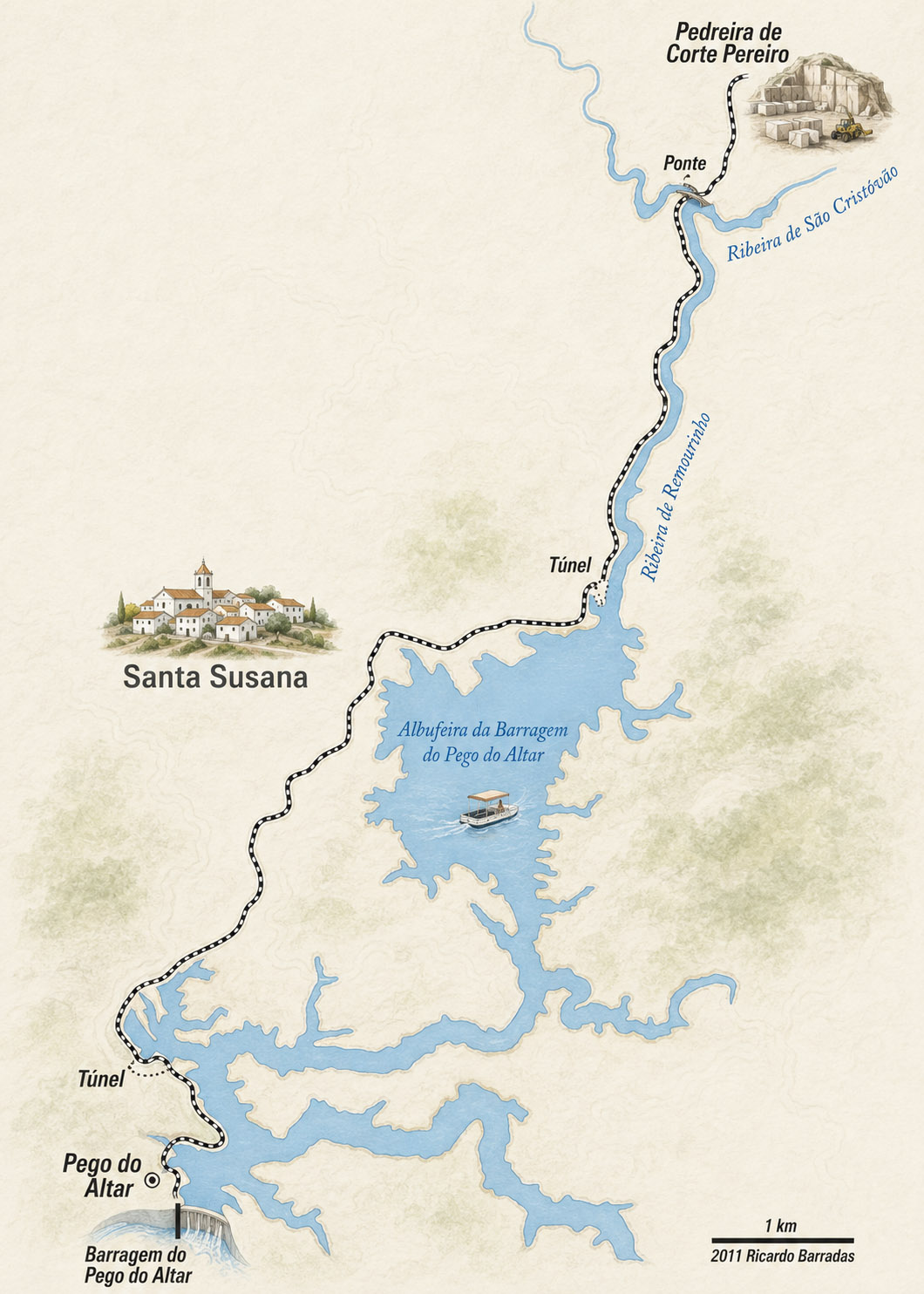
Approximately ten kilometres long, the railway began near the village of Pego do Altar, where the workshops for maintaining the locomotives and other rolling stock were located. It then ran northwards, skirted Monte das Mourarias and approached Santa Susana.
From there the line followed the right bank of the Ribeira de Remourinho for several kilometres. After crossing a tributary, it curved towards the Corte Pereiro quarry.
Two tunnels
The terrain required two short tunnels to be driven through rock. Parts of the tunnel crowns were reinforced with cement and the side walls were faced with masonry.
A metal bridge
A tributary of the Ribeira de São Cristóvão was crossed by a bridge approximately 30 metres long, supported on two masonry piers and carrying a metal deck.
Built to a high standard
Despite the sharp curves and the temporary nature of the railway, its embankments, cuttings and engineering structures show a standard of construction unusual for a simple contractors’ railway.


Locomotives, wagons and many questions
Research into small industrial railways is almost invariably hampered by a shortage of documentation. In the case of Pego do Altar, the chronology, the origin of the locomotives and the fate of the equipment after closure remain partly uncertain.
The railway appears to have been built in 1939 or 1940, as it is already mentioned in a 1940 scheme to alter the stream diversion gallery. After the dam was completed, the railway was dismantled.
Roberto Joaquim Pombo Consciência, who as a child witnessed the construction works and the inauguration, recalled that the metal bridge deck remained stored for many years in the former railway workshops, beside the restaurant later run by his family.
According to the same testimony, the locomotives were said to have come from Morocco. This has never been confirmed. The total number of engines is likewise uncertain — although there were at least two — as is their fate after 1949.
The photographs support only a few cautious conclusions. The locomotives appear to have been tramway-type steam engines, probably of standard gauge. The wagon fleet included low-sided platform wagons and twin-hopper wagons. A separate Decauville system also operated around the construction site, using small hand-propelled tip wagons.


A surviving railway landscape that can still be explored
Although the track has disappeared, the route remains largely traceable. Some sections are used as public tracks, embankments survive, the tunnels remain accessible and the bridge piers still stand.
The Pego do Altar Reservoir Management Plan, approved in 2005, sought to strengthen the area’s tourism potential. The document itself allows for the creation of walking, equestrian and cycling routes using existing tracks and paths.
What can still be seen
Decades after the track was lifted, the remains are surprisingly well preserved. The former trackbed is intact in several places, considerable ballast survives, the bridge piers appear to await a new deck, and at least one of the tunnels still seems structurally sound.
Restoring the route as a greenway could create a new visitor attraction for the municipality of Alcácer do Sal while also giving greater prominence to the history of the dam and the railway that made its construction possible.


The Pego do Altar Dam Railway had a short life, but it performed a vital function. Without it, moving hundreds of thousands of tonnes of stone across difficult terrain would have been far slower and more costly.
Today its route is a record of engineering, labour and the transformation of the Alentejo landscape. Preserving it and making its course intelligible would restore an important part of that history to the region.
Thanks are also due to Rui Jorge Consciência for making the photographs available, and to his father, Roberto Joaquim Pombo Consciência, for his recollections and information about the years when trains carried stone continuously to Pego do Altar.
Text adapted and revised from the original article by Ricardo Barradas, published in O Foguete, No. 24, in 2010.
Comments
There are no approved comments yet.