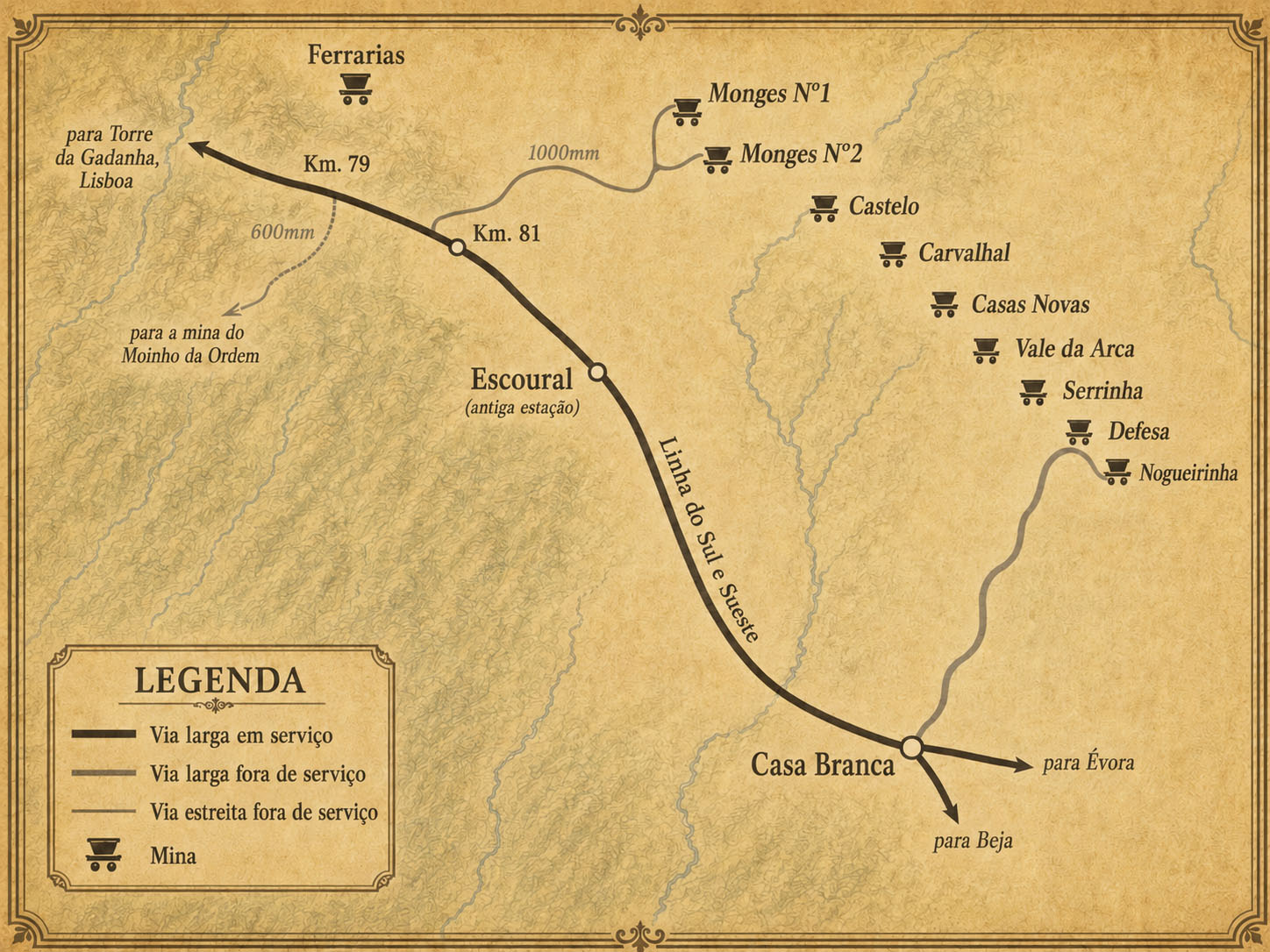
The so-called Montemor-o-Novo Iron Mines occupied a mineralised belt some twelve kilometres long, extending across the civil parishes of São Mateus, Santiago do Escoural and São Brissos, in the municipality of Montemor-o-Novo.
Running parallel to the Sul e Sueste main line, this area extended from the Herdade da Nogueirinha estate in the south-east to the Herdade da Gamela in the north-east. It comprised the mining concessions of Nogueirinha, Defesa e Sala, Serrinha, Vale da Arca, Casas Novas, Carvalhal, Castelo, Serra dos Monges No. 2, Serra dos Monges No. 1 and Ferrarias.
Remains found at the Serra dos Monges No. 1, Ferrarias and Nogueirinha mines indicate mining and smelting activity from Roman times, possibly continuing in later periods. Modern mining, however, only became significant in the nineteenth century, after the Serra dos Monges No. 1 concession was granted in 1866.
Technical problems, financial difficulties and market fluctuations prevented regular working. Even so, some of these mines experienced periods of intensive activity and acquired their own short railways to carry ore to the main-line network.
In the 1940s, after the mine railways had already been abandoned, a study by the Direcção-Geral de Minas e Serviços Geológicos concluded that the principal deposits were virtually exhausted, with only small quantities of lower-grade ore remaining. In practical terms, this marked the end of the Montemor-o-Novo Iron Mines.
The Monges No. 1 mine railway
The ministerial order concerning the discovery rights to the Serra dos Monges No. 1 mine was granted to Cartaxo Street C.º on 4 August 1865. The company obtained a provisional concession on 12 November 1866 and the definitive concession the following year.
Although the ore from the mine was claimed to be superior in quality to that of Bilbao and only slightly inferior to that from the island of Elba, then regarded as among the finest in Europe, the first years of working fell short of expectations.
Four years later, engineer João Ferreira Braga reached a similar conclusion. In an 1872 report, he considered that working had been intermittent because there was no connection with the Sul e Sueste railway, freight rates were high, transhipment arrangements to ships at Barreiro were inadequate, and iron prices on foreign markets were low.
The year 1872 nevertheless marked the beginning of the mine’s most important period. A rise in the international price of iron coincided with a reduction in railway freight rates, authorised by a ministerial order of 7 February that year. In return, the measure required the annual carriage of at least 25,000 tonnes of ore.
Cartaxo Street C.º then proceeded with the construction of a mine railway to connect the workings with the main-line network. The exact date on which work began is not known, but by June 1872 the earthworks and minor civil-engineering structures were almost complete and tracklaying was under way.
A line about 4.2 kilometres long
The railway left the Sul e Sueste main line at kilometre 81[1] and climbed on a gentle but continuous gradient to the vicinity of the mine.
Gravity transhipment
At kilometre 81 there was a hopper through which ore could be discharged directly from the mine wagons into broad-gauge wagons. A height difference of about four metres made the operation possible.
Possible reversing triangle
Contemporary mapping suggests the existence of a triangle used to turn the mine’s small locomotives. The Sul e Sueste railway also provided a siding for the wagons assigned to ore traffic.

Near the workings, the line divided into two branches. One ran northwards towards inclined plane No. 1, also known as the Convento incline, beside the ruins of the Convento dos Monges[2]. The second branch ran to inclined plane No. 2, or São Jorge, farther south.


According to engineer Bartissol, the line was built to metre gauge[3]. If this figure is correct, it would have been the only metre-gauge railway in southern Portugal. Later sources give a gauge of 600 millimetres, but that dimension probably refers to the Decauville lines used within the workings and between the mine galleries and the inclined planes.
Two small steam locomotives were acquired for the railway[4], weighing about seven tonnes each, together with an unknown number of ore wagons. Surviving photographs show saddle tank locomotives with a 0-2-0 wheel arrangement, outside cylinders and a distinctive spark arrester fitted to the chimney. They were most probably of British manufacture.

Bartissol’s report also makes it possible to reconstruct how the railway operated. Loaded mine wagons ran downhill by gravity to kilometre 81, where the ore was transferred to the railway company’s 7.5-ton broad-gauge wagons. As a rule, the locomotives did little more than haul the empty mine wagons back to the mine.
Coordination between the two systems was not always perfect. When the mine wagons arrived and no broad-gauge wagons were available, the ore was tipped on the spot. It was later reloaded into wagons kept beside the hopper and finally transferred to Sul e Sueste wagons.
For several years, international market conditions favoured the mine. In 1875 the Monges mine employed around 350 workers and exported approximately 60,000 tonnes of ore. The boom was short-lived, however. In 1879 falling prices, caused chiefly by competition from the Bilbao mines, brought operations to a halt and the railway was lifted.
The fate of the two locomotives remains unknown. They were probably sold for use on other railways, either in Portugal or abroad. Despite its brief existence, from 1872 to 1879, the branch left traces that can still be recognised on the ground, including the substantial embankment near the Convento dos Monges.
The Nogueirinha mine railway
The Nogueirinha mine was first registered in 1871 by Rufino Basílio Rachão. The definitive concession was not granted until 13 August 1873, to James Hall. Over the following decades the mine alternated between periods of intensive working and periods of closure, passing through several concessionaires before reaching the firm Henry Burnay & C.ª in 1911[5].
Working ended in 1929 and, in 1937, a formal application was made to suspend mining operations. Before then, however, Nogueirinha had benefited from an important railway connection: a broad-gauge branch about five kilometres long, linking the mine with Casa Branca station.
Unlike at Monges, the branch was worked by the Companhia do Sul e Sueste’s own locomotives and wagons. It carried not only ore from Nogueirinha but also material from the Defesa, Serrinha and Vale da Arca mines, which were connected to the Nogueirinha loading point by a Decauville system.

In his 1876 report, the engineer justified construction of the branch as necessary to avoid congestion at Casa Branca station. Traffic on that scale, he wrote, would cause delays and operating difficulties that would be particularly hard to resolve on a railway still administered by the State.
Estimated cost of building the branch
In his 1876 report, Bartissol gave the following estimate for construction of the Nogueirinha line:
| Work or supply | Estimated cost |
|---|---|
| Land purchase — 5 hectares at 1,000 francs | 5 000 fr. |
| Earthworks — 10,000 m³ at 1 franc | 10 000 fr. |
| Civil-engineering works — two culverts at 1,000 francs | 2 000 fr. |
| Ballasting with ordinary earth — 9,000 m³ at 1 franc | 9 000 fr. |
| Rails and fittings — 75 kg at 0.18 francs | 13.50 fr./m |
| Sleepers — one per linear metre | 4.00 fr./m |
| Tracklaying | 4.00 fr./m |
| Track cost per metre | 21.00 fr./m |
| Main line and station — 4,000 + 500 metres, at 21.50 francs | 96 750 fr. |
| Total for principal works | 122 750 fr. |
| Loading facilities and contingencies | 8 210 fr. |
| Total estimated expenditure | 130 960 fr. |
Figures transcribed and presented in accordance with the original estimate, in francs.
The exact date of construction remains uncertain, but the branch appears to have been built after 1876. Nor can it be established that Bartissol’s proposals were followed in full.
The production forecasts proved overly optimistic[6]. On 26 April 1926, Banco Burnay sought permission to lift the rails, but the application was refused. With the end of mining operations three years later, the line was inevitably abandoned.
Evidence of the branch still survives on the ground. For many years traces of its starting point remained visible at Casa Branca station, including the connecting turnout, which was removed only recently. Near the former Nogueirinha mine, short lengths of track with rails and sleepers survive, together with embankments that make it possible to follow part of the former alignment.


Two railways, two solutions
The Monges and Nogueirinha branches represented two very different technical solutions to the same problem: conveying ore to the main-line railway.
At Monges, a short metre-gauge railway, its own locomotives and the use of gravity carried the ore to kilometre 81. At Nogueirinha, a broad-gauge branch allowed Companhia do Sul e Sueste trains to run directly into the mining area.
Both railways were short-lived, their fortunes constrained by the international market, operating difficulties and the progressive exhaustion of the ore deposits. They nevertheless remain distinctive examples of the relationship between mining and the railway in the Alentejo.
Text adapted and revised from Ricardo Barradas’s original article, published in O Foguete, no. 19, in 2008.
Bibliography
- Minas de Ferro de Montemor-o-Novo, Direcção-Geral de Minas e Serviços Geológicos, Lisbon, 1949.
- LEAL, Augusto S. A. B. P., Portugal Antigo e Moderno, Editora de Mattos Moreira & Companhia, Lisbon, 1875.
- BRAGA, João F., Relatório acerca das Minas de Ferro da Nogueirinha, Defesa, Serrinha, Vale d'Arca, Castelo e Ferrarias, Lisbon, 1872, Arquivo da Repartição de Minas.
- SILVA, António M., Relatório de reconhecimento da Mina do Sítio do Carvalhal, 1901, Arquivo da Repartição de Minas.
- BARTISSOL, Rapport sur les Gisements de Minerai de Fer Magnétique de San Thiago, Province de Alemtejo, Portugal, 1876, Arquivo da Repartição de Minas.
Notes
- Now the Linha do Alentejo, between Torre da Gadanha and the former Escoural station. ↩
- The Convento dos Monges is also known as the Convento de Nossa Senhora do Castelo das Covas de Monfurado. The 1755 earthquake severely damaged the building while it was still under construction. The first Mass was celebrated in 1783, and the 1834 decree suppressing the religious orders led to its abandonment. ↩
- Some later sources give a gauge of 600 mm. This probably refers to the internal Decauville lines, while the main branch would have been metre gauge. ↩
- A work published in 1949 refers to four locomotives, in contrast with the two mentioned in other sources. ↩
- The firm Henry Burnay & C.ª, later Banco Burnay, was founded by Henry Burnay and was associated with several railway ventures. ↩
- Bartissol forecast annual production of 100,000 tonnes for Nogueirinha, Defesa, Serrinha and Vale da Arca combined. In fact, these mines exported about 137,406 tonnes over their entire working lives. ↩
Comments
muito interessante