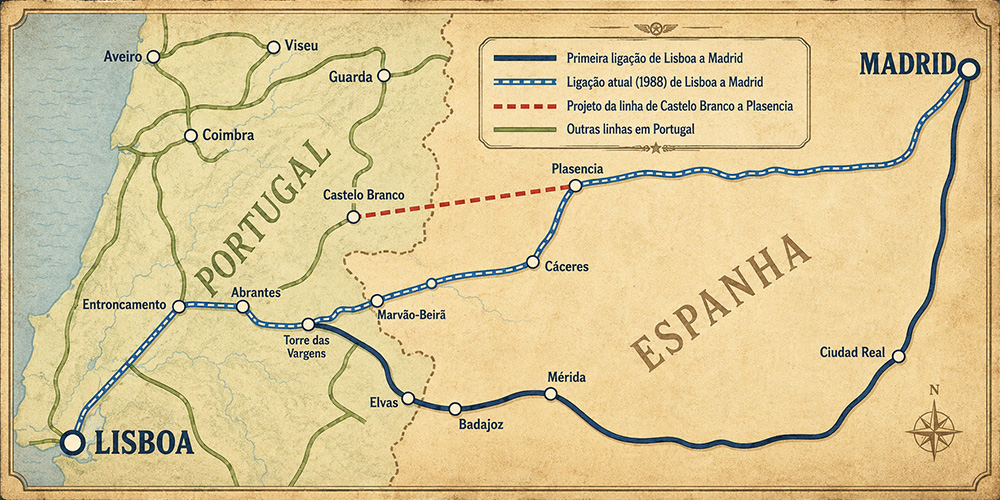
The need to reduce railway journey times between Lisbon and Madrid is by no means recent. As early as the second decade of the twentieth century, the slowness of services between the two Iberian capitals was already the subject of intense debate.
The press of the period frequently criticised the approximately sixteen hours required to complete the journey on a train which, despite being described as an ‘express’, was still far from providing a genuinely competitive connection.
The arguments for a more direct route were numerous. Lisbon and Madrid remained largely turned away from one another, despite having a combined population of almost two million. A shorter railway could strengthen relations between Portugal and Spain, stimulate bilateral trade and significantly increase the number of foreign visitors to Lisbon.
It was also argued that a fast connection to Madrid would consolidate the Port of Lisbon as the principal port of the Iberian Peninsula, in direct competition with Vigo, then one of its strongest rivals. Lisbon could also establish itself as one of the shortest gateways between Europe and the Americas.
António Birne Pereira and the reduction of journey times
In an interview published by Diário de Notícias on 22 January 1928, António Birne Pereira stated that, even after comprehensive track strengthening, the Lisboa-Rossio–Marvão–Madrid-Delicias journey could scarcely be completed in less than eleven hours.
The estimate assumed 45 kg/m rails in 18-metre lengths, locomotives with an 18-tonne axle load, and the strengthening of every bridge for the higher loads. At least another 45 minutes would have to be added for customs formalities at the frontier.
According to Birne Pereira, any genuinely substantial reduction would require new deviation lines wherever upgrading the existing routes would not suffice. In Portugal, the alignment would need extensive improvement and a new connecting line would have to be built. In Spain, the solution would require an entirely new railway from the frontier to Madrid.
All upgraded or newly built lines would require curve radii of at least 500–600 metres and gradients no steeper than 10 mm/m. Only with such standards could trains run at about 90 km/h and reduce the Lisbon–Madrid journey to approximately seven hours.
The Castelo Branco–Plasencia proposal
It was against this background that the proposal for a railway between Castelo Branco and Plasencia gained momentum, crossing the frontier in the area between Salvaterra do Extremo and Monfortinho.
The idea was not entirely new. Decades earlier, a railway had already been envisaged along the Tagus valley towards the Spanish frontier, passing relatively close to Castelo Branco.
On 19 April 1845, the Companhia das Obras Públicas de Portugal was granted the concession to build a railway along the Tagus, linking Lisbon with the Spanish frontier. This is generally regarded as the first official document relating to railway construction in Portugal.
Later, in January 1876, the engineer Sousa Brandão put forward a scheme for a line starting at Abrantes, following the right bank of the Tagus and the valley of the River Ponsul, a tributary of the Tagus. The alignment would pass about ten kilometres from Castelo Branco and continue towards the frontier near Salvaterra do Extremo.
Under this new route, the railway distance between Lisbon and Madrid would fall to about 603 kilometres, compared with approximately 799 kilometres over the route then used via Badajoz.
The opening in 1880 of the Cáceres branch, between Torre das Vargens, Marvão-Beirã and Cáceres, shortened the journey between the two capitals and contributed to the abandonment of Sousa Brandão’s scheme.
Nevertheless, a railway was eventually built along the right bank of the Tagus from Abrantes to Vila Velha de Ródão, before turning north towards Castelo Branco, Covilhã and Guarda: the Beira Baixa line.
The General Plan for the Railway Network
During the 1920s, the scheme returned to the agenda. On 11 June 1927, a commission was appointed to revise the General Plan for the Mainland Railway Network.
In its report, the commission acknowledged the value of a line which, starting at Castelo Branco, would cross one of the largest and potentially richest, but also least developed, areas of the Beira Baixa, and connect with the Spanish railway network in the frontier district of Salvaterra do Extremo.
The new railway was presented as infrastructure of major importance to the country’s economic development and particularly to the province of Beira Baixa. It is no exaggeration to say that, for a time, the connection came relatively close to being realised.
Works required on Portuguese territory
To accommodate fast trains between Lisbon and Madrid, several sections of the Portuguese network would have required intervention. The works would begin at Entroncamento, since the railway between Lisbon and that junction was considered adequate.
Entroncamento–Abrantes: The line would have to be doubled, taking advantage of earthworks formed for double track when the route was originally built. Several bridges would also require strengthening, notably the bridge over the Rio Torto on the approach to Abrantes station in the direction of increasing kilometrage. Its restricted clearance had already caused a number of accidents, earning it the popular name ponte corta-cabeças — the ‘head-cutter bridge’.
Abrantes–Vila Velha de Ródão: This section would require improvement chiefly to its horizontal alignment, increasing curve radii to 500 or 600 metres. Its longitudinal profile, by contrast, was regarded as satisfactory. The permanent way would be relaid with 45 kg/m rail in 18-metre lengths. Bridges and viaducts would likewise need strengthening for locomotives imposing axle loads of 20 tonnes.
Vila Velha de Ródão–Castelo Branco: This was regarded as the most difficult section. It had gradients of up to 18 mm/m and numerous curves of only 300 metres radius. The radii would have to be increased to 500 or 600 metres, while the permanent way, bridges and viaducts would require strengthening, as on the previous section. The longitudinal profile, however, could not readily be altered.
Castelo Branco–Salvaterra do Extremo: The new line would leave Castelo Branco towards the north-east, approaching the River Ponsul and following its right bank. It would cross minor ravines and watercourses as far as the vicinity of Idanha-a-Nova.
At that point, the railway would cross to the left bank, where a station would be built to serve this important agricultural district. This first section, approximately 26 kilometres long, was not expected to present significant engineering difficulties.
The scheme included a masonry bridge of 20–30 metres over a stream flowing into the Ponsul, together with a three-arch bridge across the river itself, with an estimated overall length of 75–80 metres. Gradients were not to exceed 10 mm/m and minimum curve radii were to be 500 or 600 metres.
Two alternatives were examined between Idanha-a-Nova and the frontier. The first followed a direct alignment to Salvaterra do Extremo. The second deviated slightly southwards towards Zebreira before turning to the frontier, adding about two kilometres to the route.
The question of national defence
The proposal also provoked a further controversy, this time concerning national security. Some circles feared that a new rail connection to the frontier might facilitate a future Spanish military operation in Portuguese territory.
During an official visit to Castelo Branco, the Minister of War, Colonel Passos e Sousa, sought to dispel those concerns. Recalling the lessons of the Great War, he argued that states could not live in isolation and assured his audience that his ministry would place no obstacle in the way of infrastructure considered important to the progress and development of the Beira Baixa.
A forgotten project
Despite the many articles published, the persistence of several regional figures, ministerial visits and the inclusion of the subject on the agenda of the Luso-Spanish Economic Conference of 11 July 1927, the railway between Castelo Branco and Salvaterra do Extremo was never built.
As with many other Portuguese railway schemes, the proposal gradually lost momentum and eventually slipped into obscurity.
It remains, however, a record of a period when a direct railway across the Beira Baixa was believed capable of bringing Lisbon and Madrid closer together, stimulating a vast inland region and profoundly altering Portugal’s role in communications between Europe and the Atlantic.
Text adapted and revised from Ricardo Barradas’s original article, published in the magazine Bastão Piloto in 1988.