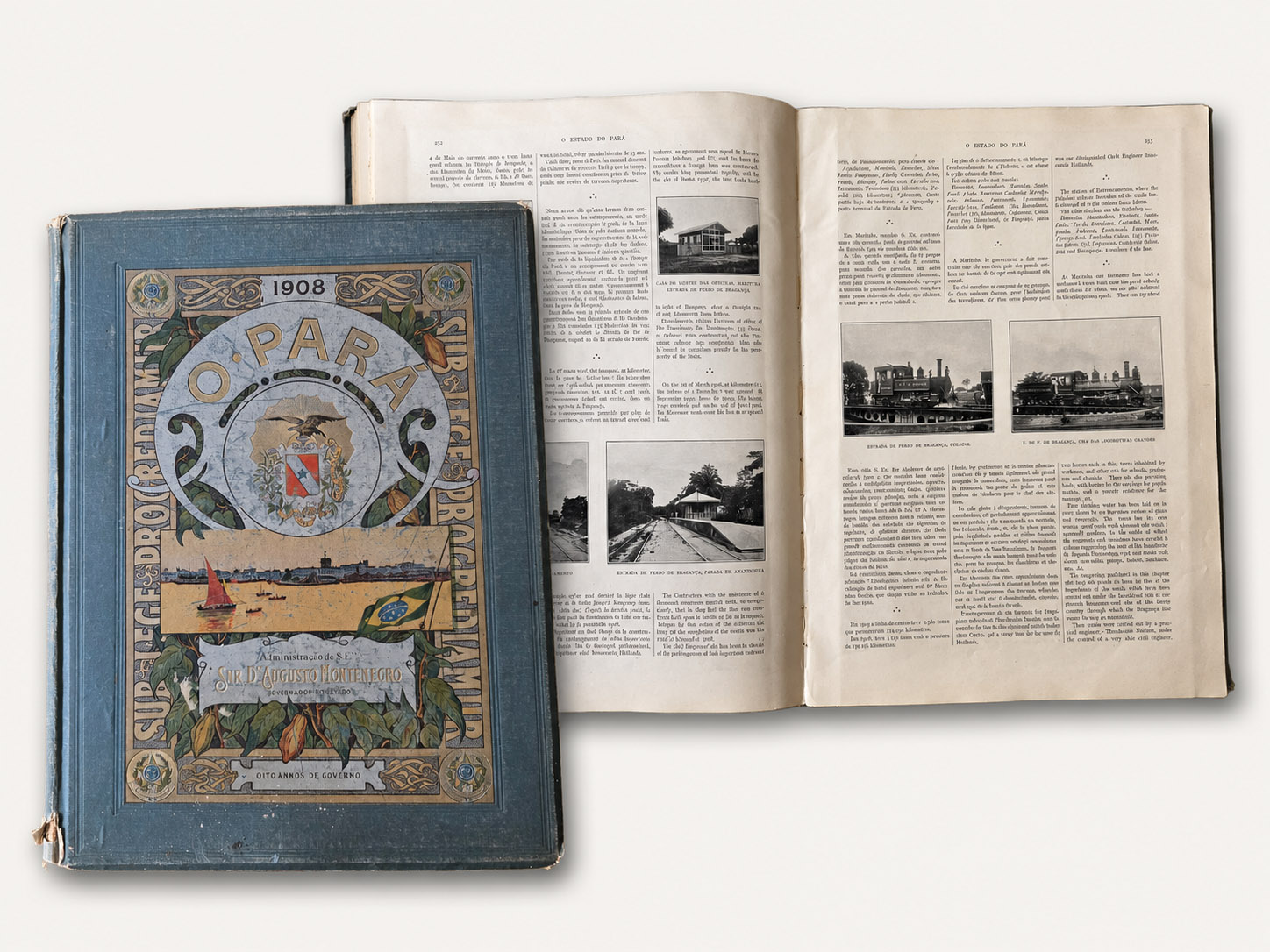
Workers’ village at Marituba, Bragança Railroad.
The idea of connecting by a rail way the town of Bragança with the Capital of Pará dates farther back than 1870, and yet it was only in 1870 that by a provincial law of the 31st of October, the government was authorized to sign a contract for the work.
On the 6th of April 1874 a new law completed the first by fixing a period of forty years as the limit of the concession to be granted for the construction of a narrow gauge-line connecting the two cities. A first contract was signed on the 15th of September 1874 with Engineer Cicero Pontes who undertook the work on the stipulated terms. But said contract remained a dead letter.
It was only in 1878 that the Governor-General, yielding to a reasonable offer made by other parties, agreed to guarantee a minimum rate of profit.
In 1882, however, the works were not yet begun, and it was only in 1883 that they were started in real earnest.
The first line—from S. Braz to Benevides (29 kilometers) was opened on the 24th of June 1884; the second, from Benevides to Santa Isabel (13 kilometers), on the 10th of March 1885; the third from Santa Isabel to Itaqui (16 kilometers), on the 17th of November 1885.
In 1887 the works from S. Braz to the centre of the town (6 kilometers) were greatly facilitated by the lines already constructed between S. Braz and Baptista Campos. Those six kilometers were opened to traffic on the 2nd of May 1893.
In 1892 and 1893 new laws authorized the construction of a branch-line in the direction of Salinas, and on the 11th of July 1894 it was resolved to lay 15,040 meters of rail between Castanhal and Marapanim.
With this object in view, a new contract had been signed on the 28th of April with M. H. de Albuquerque. The cost per kilometer being fixed at 50 contos (paper) the rate of exchange being at fifteen farthings for every «mil reis».
From the above statements the reader will have an idea of the slow progress made in constructing this line, which on the 1st of February 1901 had not got any farther than 121 kilometers.
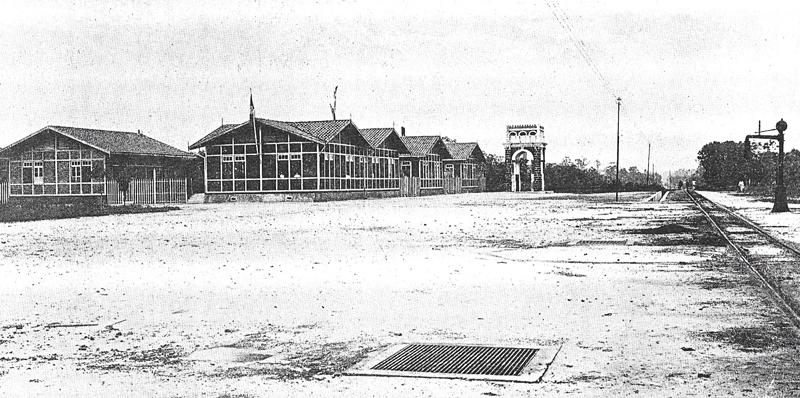
Panorama of the workers’ village at Marituba, Bragança Railroad.
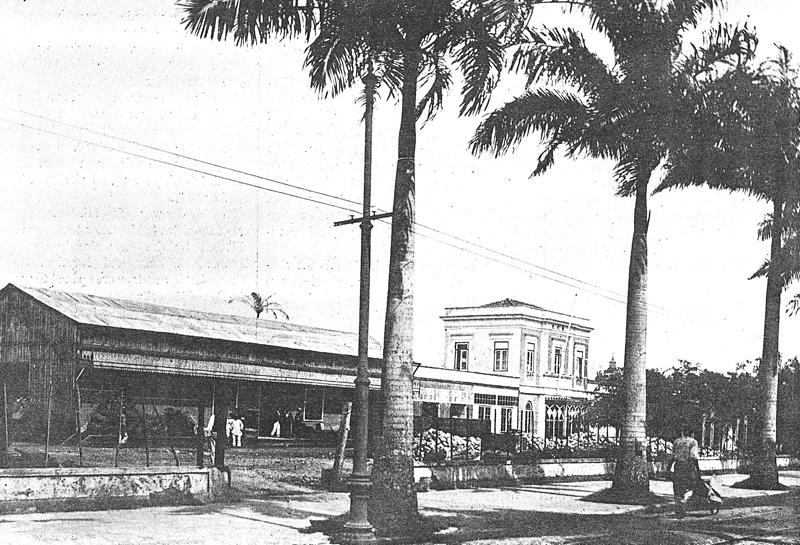
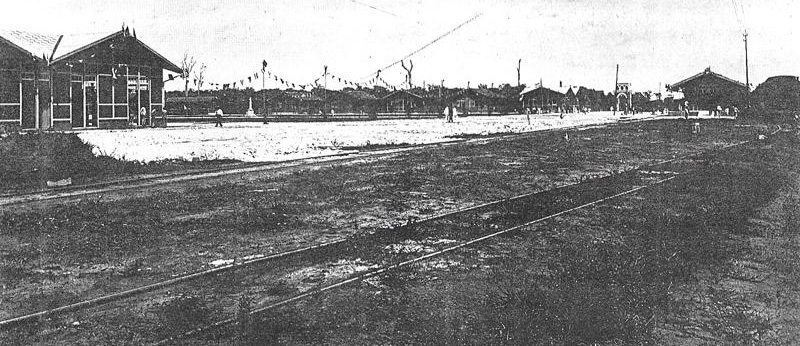
Belém station, Bragança Railroad.
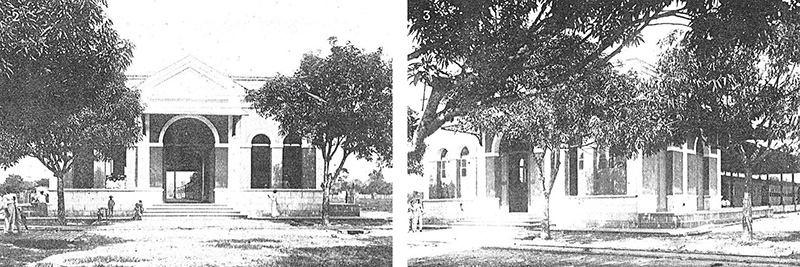
Pinheiro station.
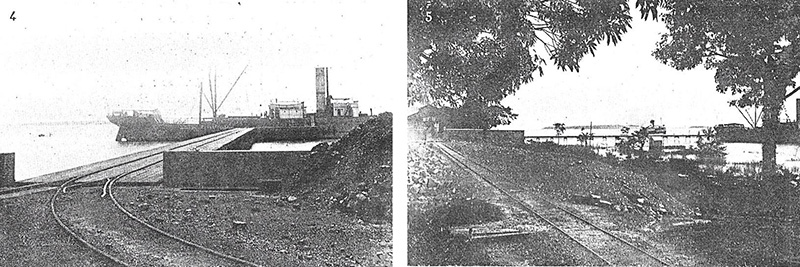
Railway bridge for unloading coal.
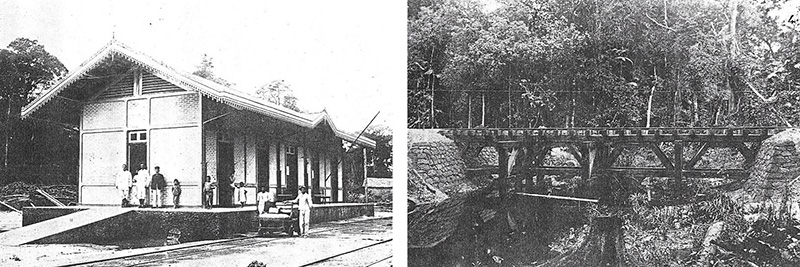
Capanema station and Capanema bridge.
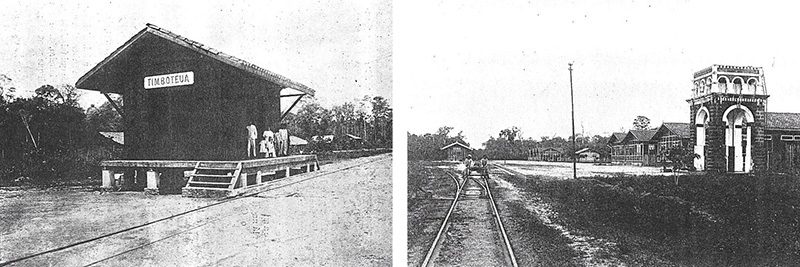
Timboteua station and the Marituba water tower, Bragança Railroad.
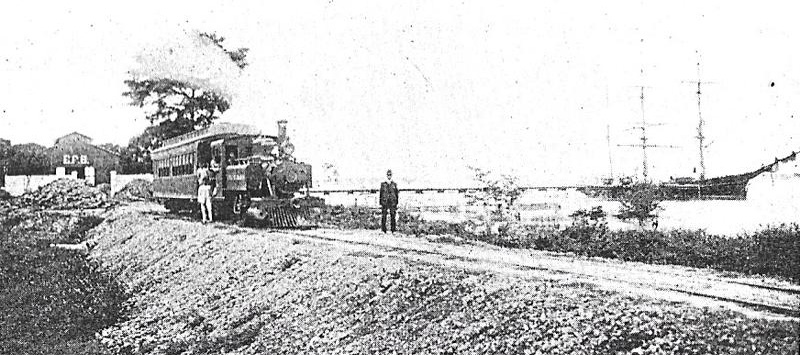
Metal bridge at Pinheiro, Bragança Railroad.
Governor, Doctor Augusto Montenegro managed to transfer the « Maranhão » contract to the « Banque du Nord » and took advantage of the opportunity to suppress, in said contract, the stipulations relating to the Salinas branch line, which was a heavy burden on the State Exchequer.
By this skilful tactic His Excellency obtained for the State a reduction of more than 4.000,000 $ 000 reis (£. 266,640) on the original contract and prevented the construction of 80 kilometers of railroad which were of no commercial value.
By way of compensation, he ordered the construction of the « Pinheiro » branch line which costs less than 850 contos (£. 56,640) This branch line was opened to traffic on the 7th of January 1906. Il is 27 kilometers long from the Belem station to « Pinheiro ». No line was ever more needed than this one. It renders the greatest service to the population, and, as will be seen further on, to the ever-increasing traffic, both in passengers and goods.
Moreover, by means of this line, the State has been able to avoid paying a subsidy which it used to pay to the river line Company in charge of the traffic in this neighbourhood.
At Pinheiro the Governor ordered a fine bridge to be built, in the shape of letter T, 133 meters long by 3 meters wide, in its longest stretch, and 33 meters by 5 meters wide, in the transversal part. At the foot of the bridge are a shed 25 meters by 14 m., and steam travelling cranes with a lifting, capacity of 5 tons for unloading coal and other goods.
The quay and block of masonry against which the bridge leans, are 109 meters long by 3 meters wide. The weight of metal employed in this bridge is 146,597 kilos, that of the shed, also made of iron, is 47,926 kilos. This bridge is connected with the station by a railroad one kilometer long.
From 1901 to 1906, the Governor, besides ordering the construction of the Pinheiro branch line, 27 meters long (double line from S. Braz to Pinheiro), had 20 kilometers of rails laid down on the main line which was 141 kilometers long, that is to say as far as the « Livramento » station. In 1906, the works for prolonging the line entered a new phase. When M. Augusto Montenegro got to the last two years of his term of office he judged that it would not be fair to leave to his successors the task of completing this important undertaking, so he did not rest until he had endowed Pará with a railway of vital importance to the prosperity of the State.
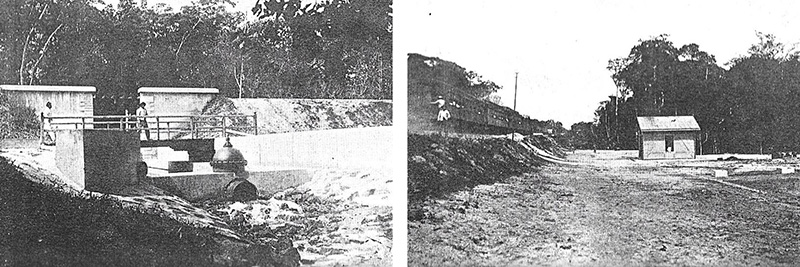
Represa Grande—Marituba’s water supply—and the site where the water was pumped.
The works on the line which had been done by pieces up to the 121st kilometer and had taken up no less than 20 years, were begun on the 23rd June 1883, in the midst of general rejoicing under the provincial Governor Viscount de Maracajú. It is due entirely to the energy and patriotism of our present Governor that this work, so greatly needed by the whole country, was finished in less than two years—two years of stubborn labour. 25 years had elapsed since the first attempts had been made to begin the track.
We have now in this line a real mine of wealth and Progress for Pará. And in a very short time this railroad will constitute a source of important revenue for the public treasury.
We have stated that according to the terms of the contract, the cost of the line was fixed at 50 contos (paper) the kilom. This price including the material for the construction of a permanent way above the line, the decorative works, the buildings, station houses and other works mentioned in contract.
After winding up the «Banco do Norte» business, an agreement was signed by Messrs. Pereira Barboza and Co; and to meet its expenditure a foreign loan was contracted. The works then proceeded rapidly, and by the 4th of March 1907, the first train hove in sight of Bragança after a straight run of 229 kilometers from Belem.
Consequently, during the term of office of His Excellency Dr. Montenegro, 135 kilom. of railroad were constructed, and the Bragança railway was completed. This line is bound to contribute greatly to the prosperity of the State.
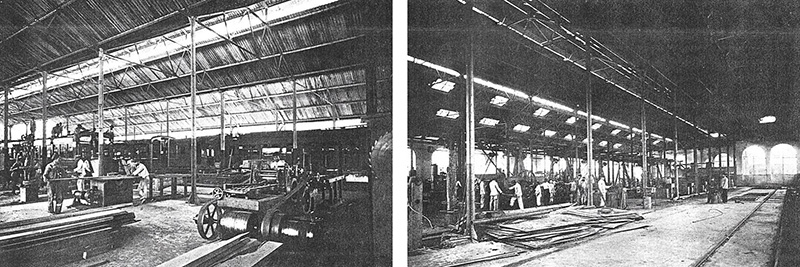
Interior of the carpentry and machine workshops.
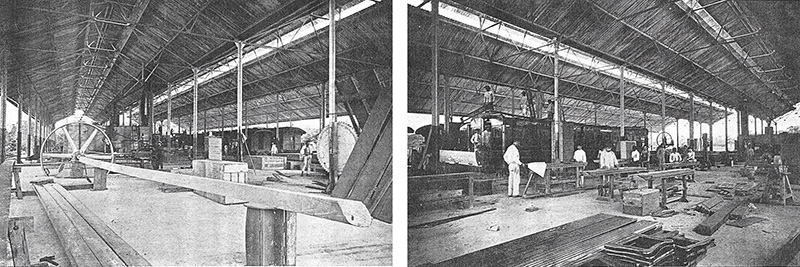
Interior of the sawmill and carriage-repair workshops.
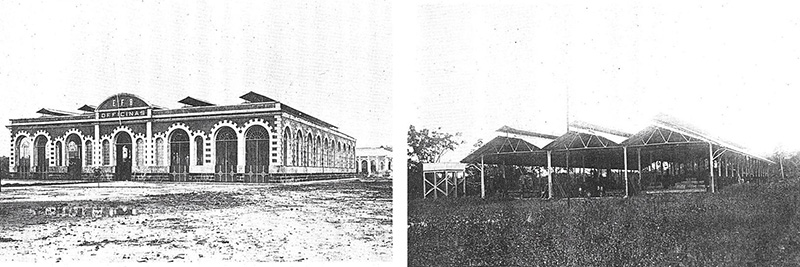
Locomotive workshops, sawmill and carriage-repair facilities.
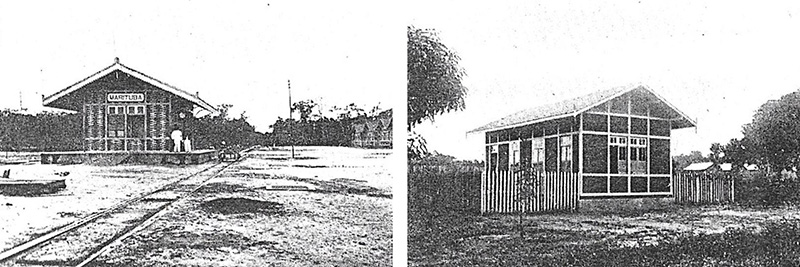
Marituba station and the workshop foreman’s house at Marituba.
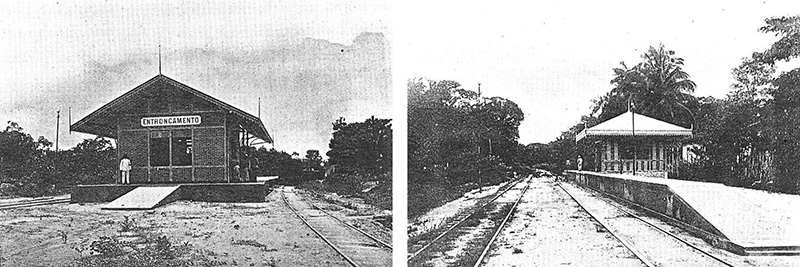
Entroncamento station and Ananindeua halt.
On the 1st of March 1906, at kilometer 163, the station of « Peixe-boi » was opened. In September 1907, piece by piece, 181 kilom. were reached, and on the 3rd of April 1908, the Governor went over the line in a special train.
The Contractors with the assistance of a thousand workmen started work so energetically, that in May last the line was completed and open to traffic as far as Bragança, whereas by the terms of the contract the limit for the completion of the works was the 15th of November 1908.
The Chief Engineer who has been in charge of the prolongation of this important railroad was our distinguished Civil Engineer Innocencio Hollanda.
The station of Entroncamento, where the Pinheiro railway branches off the main line, is situated at 9,960 meters from Belem.
The other stations are the following:—
Benevides. Ananindeua, Marituba, Santa-Isabel, Apehú, Americano, Castanhal, Marapanim, Anhanga, Jambuassú, Livramento, Igarapé-Assú. Timboteua (kilom. 153), Peixe-boi (kilom. 163), Capanema, Quatipurú (kilom. 209) and Bragança—terminus of the line.
At Marituba our Governor has had a workmen’s town built near the great railway work-shops for which we are also indebted to his enterprising spirit. There are 17 sets of two houses each in this, town inhabited by workmen, and other sets for schools, professors and chemists. There are also provision sheds, with houses for the employees, a police station, and a private residence for the manager, etc.
Pure drinking water has been laid on in every house by an ingenious system of pipes and reservoirs. The town has its own sewers; good roads with pleasant side walks; agreeable gardens, in the midst of which the engineers and workmen have erected a column supporting the bust of His Excellency M. Augusto Montenegro, and vast sheds with steam saw-mills, pumps, boilers, machines, etc., etc.
The engraving published in this chapter will help the reader to form an idea of the importance of the works which have been carried out under the beneficient rule of our present Governor—and also of the lovely country through which the Bragança line wends its way so successfully.
These works were carried out by a practical engineer,—Theodomiro Martins, under the control of a very able civil engineer, Maximino Corrêa, who was in sole charge of all the works of Marituba.
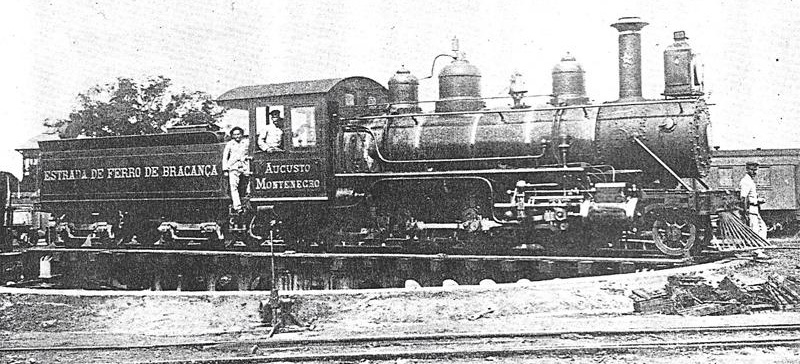
One of the new locomotives of the Bragança Railroad.
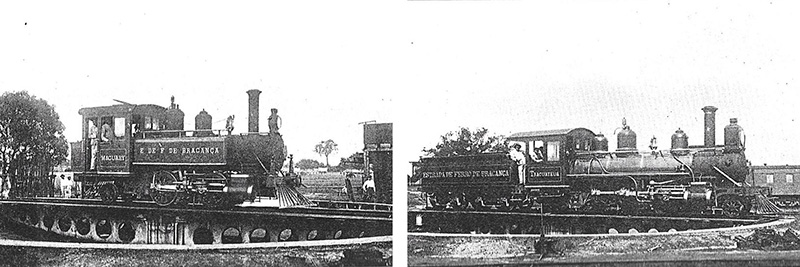
Locomotives on the turntable, Bragança Railroad.
In 1905, on the main line, as many as 2,580 trains ran from one end of the line to the other covering 224,489 kilom.
In 1906, we find 3.152 ran over the line, covering 244.233 kilom.
During the first six months of 1907, the distance covered amounted to 142,302 kilom. There is every probability that the number for the whole year will not be far from 300,000 kilom.
In 1906 there were 572 trains more than in 1905, and the increase was still more important in 1907.
In 1906 the total traffic of the line, including the Pinheiro branch, amounted to 5,234 trains, with runs covering 309,562 kilom.
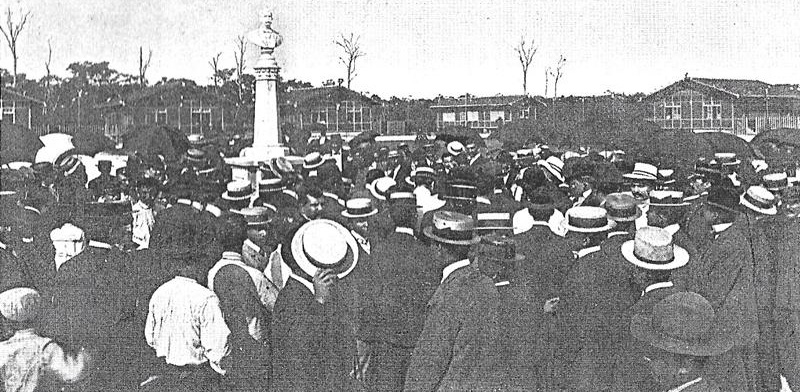
Unveiling of the bust of Doctor Augusto Montenegro at Marituba.
The traffic cost Rs. 244,530 $ 174 (£ 16,302) representing an average per train of Rs. 46 $ 719 £ 3.2.5.), and per kilometer of $ 789 reis (one shilling). By comparing these figures with those of 1906 we find a reduction of 30 o/o in the expenses incurred in working the line
From the point of view of the cost of a train per kilometer, there is evidently great improvement, and not only in cash receipts, but also in the cost of combustible. In 1905, wood was used to work the engine, whereas in 1906 coal was substituted.
Between the first six months of 1906 and the first half of the year 1907, we find that trains running over the line show an increased circulation of 63,364 kilometers in favour of 1907. This increase is to be attributed to the extension of the traffic as far as « Peixe-boi ».
For the Pinheiro branch alone the traffic in 1906 brought into action 2,082 trains, covering a distance of 65,327 kilometers.
The cost of traction per kilometre train amounts to 0 $ 625 reis (11 pence) i. e. 0 $ 208 reis less than on the main line. This difference is due to the fact that the branch-line is supplied with powerful engines which allow of trains being made up with 8 cars and even more; whereas on the main-line, trains cannot be run with more than five cars.
In 1906, on the main-line, there were:—
Travellers ........................ 168,739
Luggage .................... tons 547
Goods ........................ — 1.486
Wood for getting up steam, and constructing material..... tons 14.598
On the Pinheiro branch-line we find during the same period:—
Travellers ........................ 181.535
Luggage .................... tons 595
Goods ........................ — 934
Wood for steam and building material
........................ tons 1.280
Total receipts of the railroad, collected by month
| Months | 1903 | 1904 | 1905 | 1906 | 1907 |
|---|---|---|---|---|---|
| January | 28:094$320 | 33:690$255 | 34:632$670 | 56:245$650 | 56:376$345 |
| February | 22:328$666 | 32:385$695 | 33:792$070 | 50:760$562 | 51:127$190 |
| March | 25:348$885 | 39:142$474 | 40:660$695 | 55:916$450 | 58:266$849 |
| April | 24:494$675 | 35:417$160 | 33:543$580 | 50:263$120 | 62:476$748 |
| May | 26:398$799 | 37:667$839 | 35:984$129 | 52:865$204 | 65:742$790 |
| June | 29:569$962 | 35:029$230 | 30:573$225 | 52:811$166 | 62:496$770 |
| July | 31:017$175 | 37:012$970 | 37:595$505 | 56:759$390 | 68:387$428 |
| August | 33:216$609 | 37:928$418 | 40:201$834 | 54:758$800 | 64:888$820 |
| September | 31:465$803 | 36:335$560 | 36:596$759 | 51:461$790 | 59:507$670 |
| October | 34:650$428 | 38:342$670 | 49:482$480 | 55:923$365 | 55:251$320 |
| November | 32:439$087 | 34:958$070 | 43:182$146 | 53:170$090 | 59:155$370 |
| December | 34:119$972 | 34:746$770 | 47:907$982 | 59:831$910 | 61:051$460 |
| Total | 353:144$381 | 440:657$101 | 467:153$971 | 650:727$497 | 735:948$760 |
Transcription of the table published in O Estado do Pará (1909).
The above receipts are equivalent to:
Year 1903 ........................ £ 23.543
— 1904 ........................ 29.377
— 1905 ........................ 31.143
— 1906 ........................ 43.381
— 1907 ........................ 49.063
This steady progression will enable the reader to form a tolerably accurate idea of what we may expect in the near future from this important railway.
The returns of the Pinheiro line, from the 8th of January to the 31st of December 1906, were 108 : 753 $ 950 (£ 7.290) and during the first six months of 1907 they amounted to 57 : 789 $ 900 (£ 7.290), and during the first half of the year 1907 to 57 : 789 $ 900, or £ 3.852.
No account is taken in the above figures of free or « dead-head » transport for the Republican Union, for the State of Pará, the Town Council, or the Company itself, while extending its lines. If all these different loads had been paid for at the scheduled rates, they would have added to the gross receipts: in 1906, over 111 : 062 $ 240 reis or £ 7.404, and for 1907 (first half of the year) over 90 : 134 $ 865 reis or £ 6.009. The total returns in 1906 were therefore Reis 761 : 789 $ 737 or £ 50.785, and for 1907 (without reckoning the second half year’s gratuitous transport) 826 : 083 $ 625 reis or £ 55.905.
During that period the line’s rolling stock included:—
17 Engines;
23 cars for travellers;
3 Luggage vans;
18 Luggage vans for goods;
2 Luggage vans for animals;
15 Luggage vans for wood and coal;
6 Small carriages;
34 Trolleys;
2 Special cars (Officers);
1 Special cars for Inspectors.
Over and above the station-house contracted for, it has been found necessary te build others, such as that of Belem in tho Capital, those of S. Braz, Santa-Isabel, Bragança, Castanhal and Pinheiro all first-class. The second-class stations are those of Igarape-assú, Marituba, etc.
The two great stations of Belem and S. Braz are important buildings, designed by a clever architect and fully supplied with every convenience for working every department of the line rapidly and safely.
The S. Braz station will be completed under the government of His Excellency M. Montenegro who is to open the building at the end of the year.
The work does great credit to the State engineers who drew up the plans, and also to our Governor who got the works done so quickly.
Moreover, after having constructed half the line, the present Government renewed all the rolling stock and fixtures. It pulled down the old station houses and set up new ones, erected fresh plants and considerably improved the permanent way. By this magnificent effort Dr. Montenegro has endowed the State with a new railroad of considerable importance. Year by year the traffic increases, full of promise for the future. We have every reason to foresee that, while yielding substantial profit to its share-holders, it will greatly add to the wealth of Pará.
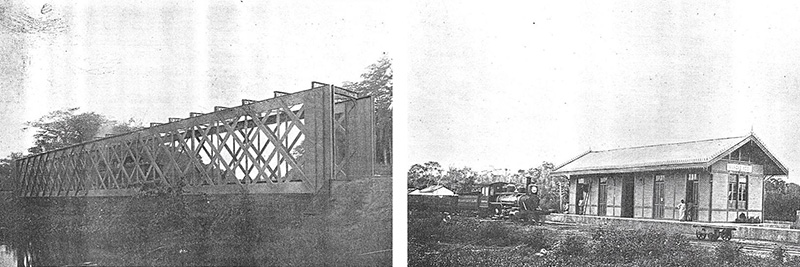
Livramento bridge and Igarapé-Assú station.
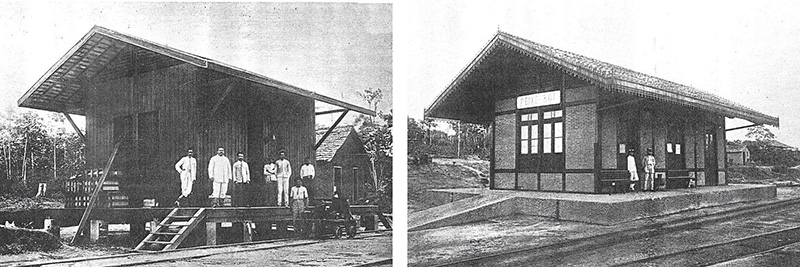
Tauary halt and Peixe-Boi station.
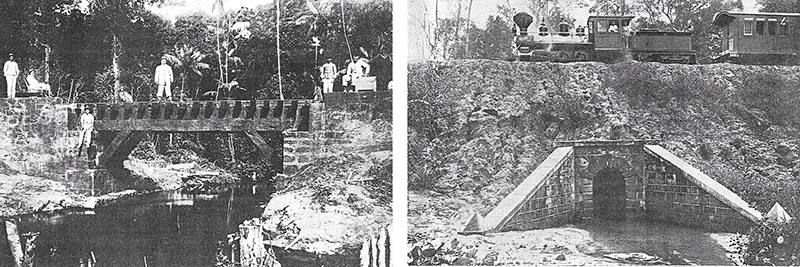
Malacacheta bridge and the large culvert.
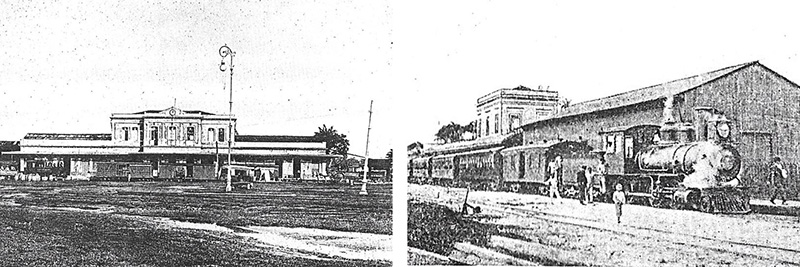
S. Braz station and Belém station.
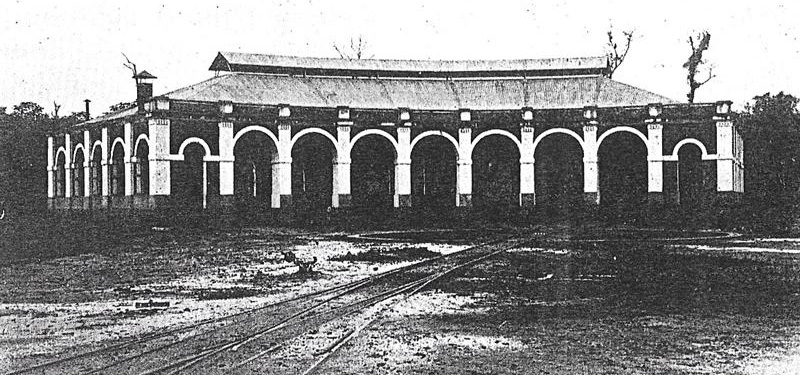
Marituba roundhouse and locomotive depot.
The « Benjamin Constant » Railway
While he was Governor (February 1897 to February 1901), Dr. José Paes de Carvalho found it necessary to connect by a railroad the Benjamin Constant Colony with the town of Bragança. To accomplish this purpose, he made a contract with a building firm for the construction of the line. The firm began the work at the rate of 17 : 000 $ 000 reis the kilometer, on Decauville narrow gauge system—with a width of 60 centimeters between steel rails weighing 9 kilos per meter.
In 1903, the present Governor discovered that scant progress was being made by the contracting firm, moreover that the work was being badly done; so he declared the contract null and void, and decided that the works should be carried out by the State engineers. And so it was completed in 1904.
This railroad, or branch of the Bragança line, is 18 kilometers long, between Bragança and the Colony. It runs past the port of Sapucaia, on the right bank of the Caeté.
Our present Governor intends to prolong the line to Gurupy, 27 kilometers distant from the Colony. This would give the line a total length of 45 kilometers.
In possession of ample rolling stock, quite new, with fine sheds for engines and cars, well-conditioned and artistic stations, connected by telephone; this branch-line renders great service and will be of still greater use when it reaches Gurupy.
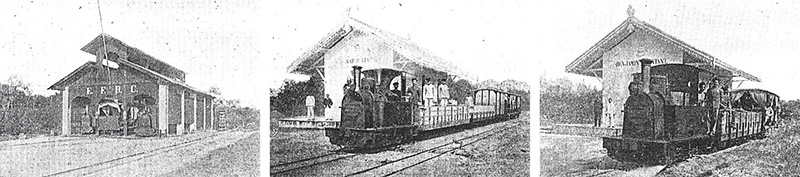
Engine and carriage shed, with Sapucaia and Benjamin Constant stations.
The Prata Railroad
This road is also a branch-line of the Bragança railway. Starting from the Igarape-assú station, it runs as far as the village of Santo Antonio do Prata where the State subsidizes an important institution for men and women. So soon as he became chief of the State, our Governor made up his mind to construct the line without loss of time.
He well knew that traffic on this line was bound to be very profitable to the Bragança railway.
The branch-line of the Prata, made with steel rails, set 60 centimeters apart, and resting on 35.100 sleepers made of «Law» wood, has a length of 20.777 meters. On either side of the line Government has distributed, grants of land to agriculturists, so that the entire region through which the line runs, will soon be completely populated. The grants distributed between Maracanã and the Prata are most fertile lands. They will grow almost anything.—Good corn stuff is exported to the Capital from this district.
The many other advantages to be derived from such a railroad, did not escape the far-seeing and highly practical spirit of our Governor. It has evidently been constructed on economical lines, but such as it is, this railway has already made an enormous difference in the receipts collected by the Bragança company, and is sure to provide this much favoured region with boundless opportunities of agricultural developments.
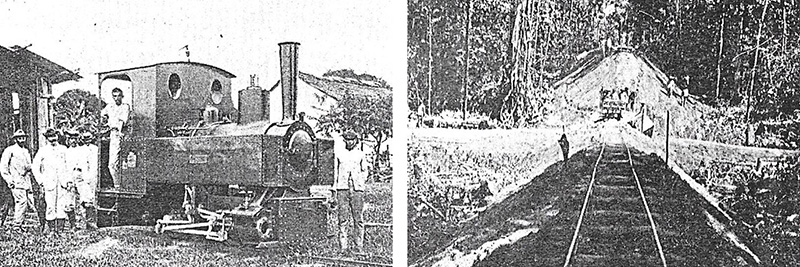
A locomotive of the Prata Railroad and construction works.
The Tocantins and Araguaya Railroad
(Compagnie des Chemins de fer du Nord du Brésil.)
For many years past, it had been intended to connect lower Tocantins with upper Tocantins and to push the line as far as S. João do Araguaya, so, as to develop this part of our territory. The line is needed to carry to the Capital of Pará the produce of four Brazilian States. And, more than ever, has this line become indispensable since the discovery of immense cauchaes (forests of caucho) in the Araguaya, and close to nearly all the affluents of the Tocantins. Farmers are waiting for this means of exporting their rich produce, and several other products which abound in this region.
It is with this object in view, that a Company was promoted, a few years ago. It was known as the «Rail and River Circulation Company of Tocantins and Araguaya». By law No. 190 of the 20th of June 1894, Government granted a special guarantee and support for the immediate construction of the necessary works.
But despite the most persevering efforts, nothing came of the venture, and in 1905 the Company found itself under obligation to raise a loan in Paris, or to fulfil the contract it had made with our Government. Later on, the « Compagnie des Chemins de fer du Nord du Brésil » to which the Government concession was turned over, imparted fresh life to the enterprise, now making steady and rapid progress.
This Company has its head quarters at Belem, and its legal offices in Paris.
Its capital is 12.500 contos, gold, or, according to the present rate of change, 20 millions of francs, divided into 500 francs shares yielding 5 % interest, gold.
By decrees No. 862 of the 16th of October 1890, and No. 3812 of the 17th of October 1900, the Federal Government granted « the Tocantins and Araguaya » a guarantee of 6 % interest for a maximum of 30 contos of reis, gold, per kilometer needed for the construction of the line, the purchase of rolling stock and fixtures, the telegraph line, and all the other indispensable items necessary to a railroad, until the line has been completed and opened to public traffic.
By decree No. 913 of November 1903, the Governor of Pará increased the guarantees allowed by the Federal Government, and granted 6 % gold on 10 contos of Reis, gold per kilometer for the construction of the railroad from Alcobaça to Praia da Rainha.
The total length of the line is 180 kilometers between Alcobaça (10 kilometers above Cameta) and Praia da Rainha. Consequently, if, as was intended, the line starts from Cameta, it will have a total length of 190 kilometers. The Company of the « Chemins de Fer du Nord du Brésil » means to ask for a new concession, which would enable it to prolong the Praia da Rainha line as far as Goyaz.
By last April it had completed the following works :—
Picketed out the line : 70 kilometers.
Sketched out a rough plan of the line as far as 65 kilometers, and laid down 18 kilometers of rails fixed on sleepers.
Following rolling stock and fixtures are now being used by the Company :—
5.000 tons of rails of 20 kilos per meter ready to be laid down.
2 new French engines, weighing each 21 tons.
1 French engine of 11 tons.
1 English engine.
1 do American.
2 drausines
8 lorries for the preserving of oil.
16 cars with platforms.
4 ditto closed.
4 ditto open.
3 sheds for housing rolling stock.
1 workshop for repairs (at Alcobaça).
1 storehouse for engines.
1 do for cars.
1 hospital erected by the « Portable House Building Company » which contains 90 beds.
1 Chemist’s shop with a first-class dispensing laboratory.
Between the starting point and the terminus are the following stations :—
1. Alcobaça.
2. Aruamatheu.
3.Breu-Branco.
4. Agua Limpa.
5. Areião.
6. Murisisal.
7. Bragagem.
8. Ponta do Cajá.
9. Praia da Rainha.
On the 31st December of this year the Company expects to open the first part of the line, i. e. as far as the station of Arua-matheu.
The space between the rails is 1 meter; about 2.000 men are working steadily at the construction of this line.
Despite the innumerable obstacles which are met with on all sides, there can be no doubt that the Tocantins—Araguaya line will be completed, and that it will greatly contribute to the development of Pará’s best interests. Our State will soon be in possession of very important lines of communication affording greater facilities for commercial intercourse between lower and upper Tocantins, also between Goyaz and other parts. Goyaz will then be able to export the greater part of its abundant produce.
During last May, 400 workmen were employed in constructing this line, and the Company was expecting from one day to the other 600 more men who had been engaged. The Company was resolved to have 1.000 men at work in June.
Since April last, the Chief Engineer of the Railway is the distinguished Brazilian civil engineer, Amyntas de Lemos, formerly vice-Director of the Bragança Railway.
in "O Estado do Pará 1909"
Source: transcription from O Estado do Pará, 1909.
Comments
There are no approved comments yet.